

Anyone who wants to cut a piece of float glass to size will reach for a glass cutter. Anyone who tries the same with a pane of toughened safety glass (ESG) will experience an unexpected lesson in applied physics—loud, full of splinters, and with a clear learning effect. The good news: the rules on which glass can be cut and which cannot are clear. You just have to know them.
This article provides the decision-making framework that all other guides fail to offer: not just the technique, but the system behind it.
What does "cutting glass" actually mean?
When cutting glass, the material is not actually separated but initially scored. The pane breaks in a controlled manner along this notch; the technique assumes that the glass contains no internal stresses.
Anyone working with a glass cutter for the first time will find that the term is misleading. The cutting wheel merely scores the surface and creates a microscopically fine notch, known as a fissure. The pane is then broken along this line. The process works reliably as long as the glass is untreated and contains no internal stresses.
With certain types of glass, this is precisely not the case, with significant consequences for anyone who tries it anyway.
Which types of glass can be cut without problems?
Float glass, mirror glass, and patterned glass can be processed with a standard glass cutter, provided the pane thickness and your own experience match. All three types of glass are produced without thermal or chemical hardening.
Float glass: The classic among cuttable glass types
Float glass is the most widely used flat glass of all. It is created by pouring molten material onto a tin bath and cooling it very slowly. This gentle cooling prevents internal stresses from building up, keeping the glass homogeneous and allowing it to break cleanly along the scored line.
According to selbst.de, float glass up to a thickness of about 6 mm can be processed cleanly by laypeople, but more experience is required for a clean result as glass thickness increases. Thicker panes require more skill because the necessary breaking pressure increases and deviations along the break line become more frequent.
Anyone purchasing float glass in standard formats or as a custom cut generally receives a material that is optimally suited for this technique.
Mirror glass and patterned glass
Mirror glass is based on float glass and behaves almost identically when cut. Important: The score line should always be made on the glass side, not on the mirrored back, so as not to damage the coating.
Patterned glass and ornamental glass, such as cathedral glass or ornamental variants like those in the Adamer range, can also be cut, but they require more uniform pressure because the profiled surface slightly deflects the cutting head.
Satin glass
Satin glass, which has been matted through chemical etching or sandblasting, is also based on float glass and can be cut without any issues. The matte surface has no influence on the mechanical properties.
Which glass must never be cut?
Toughened safety glass (ESG) cannot be cut after the hardening process; any attempt will immediately destroy the pane. While laminated safety glass (VSG) can technically be cut, it requires special tools for the interlayer film and should only be processed by a specialist company.
ESG: Why every attempt to cut it destroys the pane
Toughened safety glass is produced by first cutting, grinding, and drilling float glass to size, and only then subjecting it to a thermal hardening process. During this process, the pane is heated to over 600 °C and then suddenly cooled. This imprints a defined compressive stress in the outer zones and tensile stress in the core material.The result is explained by the material properties: tempered glass is four to five times stronger than normal glass and breaks into small, blunt-edged pieces instead of sharp splinters, which significantly reduces the risk of injury upon breakage. The price for this: this tension balance is highly sensitive. Anyone who tries to cut a finished ESG pane triggers the entire tension system instantly. The pane shatters into thousands of small, blunt-edged fragments.
This is not a defect; it is exactly what ESG was designed for. The fragmentation characteristic protects people in the event of breakage. However, for the DIY enthusiast, it means: custom cut requests must be made before hardening.
At a specialist company like Adamer, which has been producing ESG and VSG since 2011, every cut is therefore made before the hardening furnace, to exact dimensions, according to customer specifications.
VSG: Possible, but not for home use
Laminated safety glass (VSG) consists of two or more layers of glass connected by a tough PVB film or casting resin. The glass layers themselves can be scored and broken with a cutting wheel. The real problem is the interlayer: it must be cut through after the glass breaks, using a heated knife or special tool that is not found in any standard DIY toolbox.
Furthermore, VSG panes based on hardened glass (VSG made from ESG) are generally not cuttable. Only VSG made from float glass allows for subsequent cutting, and even then, the quality of the cut is difficult to control without professional equipment.
Anyone who needs custom-sized VSG will find a safer and generally more economical solution at a specialist company. Our article on custom-made safety glass explains more about the areas of application and construction variants.
Overview table: Which glass can be cut?
|
Glass type |
Cuttable? |
Who can cut it? |
Special feature |
|
Float glass |
Yes |
DIY / Professional |
Well suited for laypeople up to ~6 mm |
|
Mirror glass |
Yes |
DIY / Professional |
Score on glass side, not back |
|
Patterned / Structural glass |
Yes |
DIY / Professional |
Uniform pressure necessary |
|
Satin glass |
Yes |
DIY / Professional |
No special features |
|
ESG (hardened) |
No |
Not possible |
Cutting only before hardening |
|
VSG from float glass |
Limited |
Specialist only |
Film requires special tools |
|
VSG from ESG |
No |
Not possible |
Combination of both restrictions |
|
Wired glass |
Limited |
Specialist only |
Wire insert must be cut separately |
Step-by-step: Cutting float glass correctly
Anyone who wants to cut float glass should not just start scoring away. The most common mistakes occur not with the cutting wheel, but before and after.
Preparation
- Work surface: A cork board or a soft, level surface prevents scratches and provides uniform support for the pane.
- Protective equipment: Cut-resistant gloves and safety goggles are not an optional extra but a minimum standard. Glass dust and splinters are created even with the cleanest execution.
- Glass cleaning: Grease, dust, and fingerprints on the cutting line significantly impair the quality of the fissure. Wipe-proof, lint-free cleaning is a must.
The cut
- Draw the glass cutter along the cutting line just once, with even, moderate pressure. Going over it multiple times worsens the fracture edge and damages the cutting wheel.
- The characteristic, uniform hissing sound indicates that the fissure is properly seated. A scratching or interrupted sound indicates too little pressure or contamination.
- For straight cuts, a metal rail is recommended as a guide.
Breaking
- Break immediately after scoring; the fissure "heals" partially after a short time, making it more difficult to break.
- Place the pane on the score line over an edge or a round rod and press down evenly. Alternatively: use pliers or breaking pliers for precise, shorter breaks.
Post-processing
- Raw fracture edges are sharp and pose a risk of injury. Sanding them down with a damp whetstone or edge tape is not an optional step, but a safety requirement.
When is a specialist company worth it and when not?
For simple straight cuts in thin float glass, the DIY enthusiast with a little practice is well-positioned. As soon as shaped cuts, larger panes, safety glass, or custom-made holes come into play, the effort exceeds the benefits of the home project.
The honest calculation: According to Hausjournal, the cutting costs at a specialist for float glass average about 25 euros; for insulating glass, prices of up to 300 euros are possible, including clean edges, no material loss due to broken pieces, and no risk of injury. Anyone who needs three attempts to get one cut right has already used up the price difference.
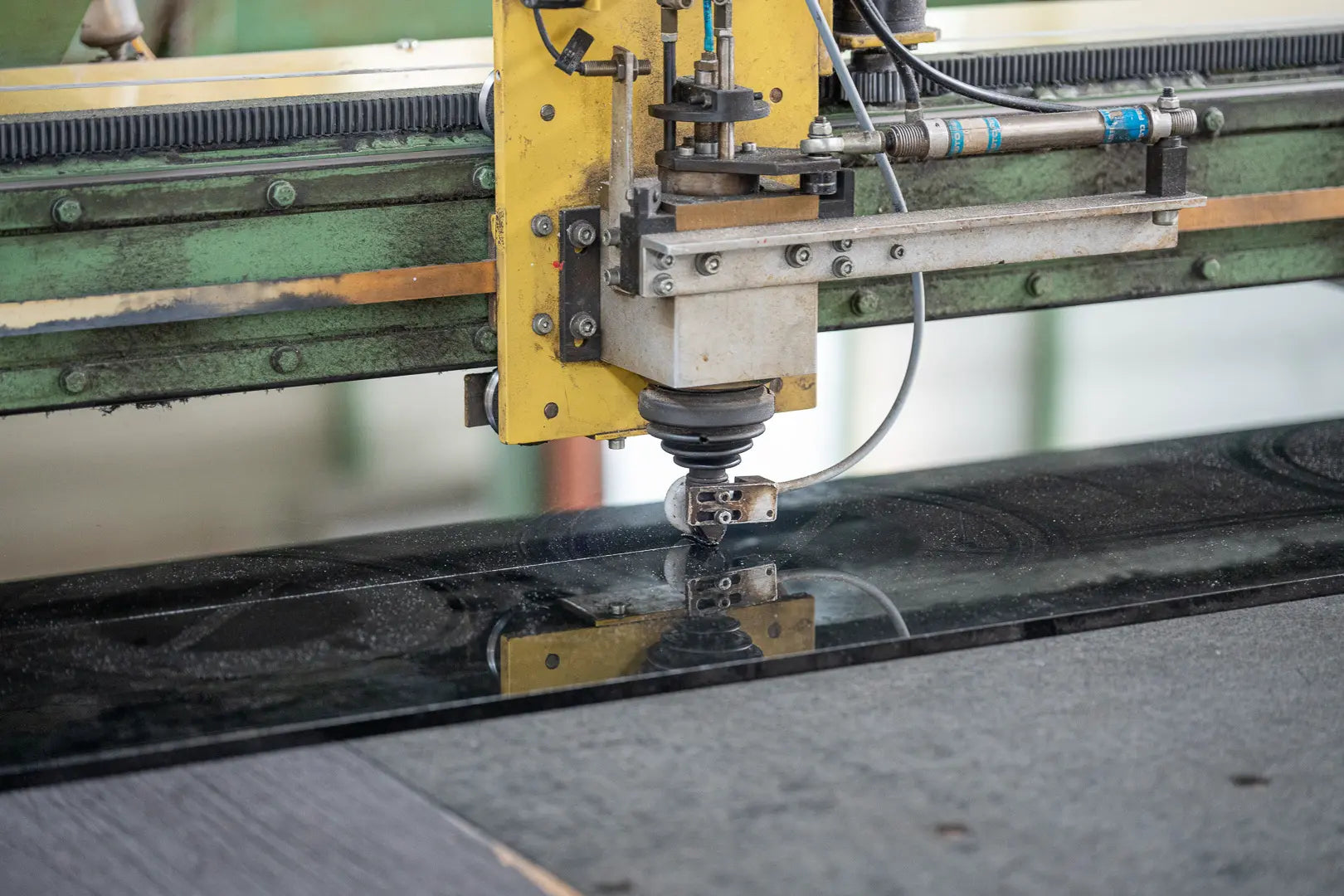
Shaped cuts, i.e., curved or free-form contours, are practically impossible for laypeople. Professional companies use CNC-controlled waterjet cutting systems here. According to STM Waterjet, these systems allow for any shaped cuts and bevel cuts up to 60° and work without heat exposure, so the structure and properties of the glass are fully preserved. This is practically unachievable for DIYers; the specialist company provides this precision as standard.
Anyone with complex requirements, from custom shower enclosures to glass partitions in the office, will find a more efficient solution at a specialized company with its own cutting service. The Adamer contact page offers a direct entry for individual inquiries.
Common mistakes when cutting glass and how to avoid them
Even experienced DIYers keep making the same mistakes when cutting glass. An overview of the most important ones:
- Going over the score line multiple times: Leads to an unclean break and damages the cutting wheel. Once, evenly, done.
- Waiting too long before breaking: The fissure regenerates. Breaking should take place immediately after scoring.
- Wrong glass type: Anyone who mistakes ESG for float glass will experience the sudden shattering of the pane. When in doubt: ask a specialist dealer or check the glass for a marking (ESG panes are usually stamped on the edge).
- No protection on the cut edges: Open glass edges are dangerous. Sanding or edge protection is always required.
- Wrong surface: A hard or uneven surface transfers vibration and causes unwanted breaks. Always work on a soft, level surface.
Glass cutting vs. ordering glass to size: An honest comparison
|
Criterion |
Cutting it yourself |
Ordering custom cut |
|
Costs |
Tools + material + waste |
From ~25 € per cut (float glass) |
|
Precision |
Good for straight cuts, limited |
CNC accuracy |
|
Glass types |
Only non-hardened glass |
All glass types |
|
Shaped cuts |
Not possible |
Standard |
|
Time required |
Medium–high (incl. learning curve) |
Low |
|
Safety risk |
Present |
Lies with the specialist company |
ESG and VSG: What Adamer has produced since 2011
Adamer has been active in the glass industry since 1857, initially as a classic glazing and trading company that processed and installed float glass, mirrors, and patterned glass. Since 2011, the company has also been producing toughened safety glass and laminated safety glass in-house.
For projects where dimensional precision and material safety must come together, this step is decisive. This is especially true for safety glass applications in construction, for glass railings, partitions, and everywhere the DIN EN 12150 standard must be met. This is also relevant in a larger context: According to a study by TNO for Glass for Europe, up to 42% of the EU's energy efficiency target for 2030 could be achieved through the installation of high-quality glazing alone—a strong argument for not making compromises when choosing glass.
For projects where dimensional precision and material safety must come together, this step is decisive. This is especially true for safety glass applications in construction, for glass railings, partitions, and everywhere the DIN EN 12150 standard must be met.
Cutting glass starts with the right choice of glass
The technique can be learned, physics is non-negotiable. Anyone planning to cut glass must first know what they are dealing with: float glass, mirror, and patterned glass can be cut; ESG cannot, and VSG only by a specialist company. Knowing these boundaries before picking up the cutting wheel saves material, time, and nerves.
For individual custom cuts and all questions regarding glass, Adamer is at your disposal; you can get in touch now or discover further specialist articles in our blog.
Frequently asked questions about cutting glass
What methods exist for cutting glass?
For non-hardened glass like float glass, four common methods are available: the classic wheel cutter, the diamond cutter, the Dremel with a cutting disc, and professional waterjet cutting. Wheel and diamond cutters are suitable for straight cuts at home. The Dremel allows slightly more flexibility in guiding the line but generates more glass dust. Waterjet cutting is the most precise method and also enables complex shaped cuts; it is reserved for the specialist company.
What does it cost to have glass cut?
The costs depend on the type of glass. For simple float glass, the cutting costs at a specialist company are on average about 25 euros. For insulating glass or laminated safety glass, prices can be significantly higher. For larger quantities, it is worth comparing offers.
What does it cost to cut a piece of glass to size?
A single custom cut from float glass typically costs from 25 euros at a specialist company, depending on format, thickness, and edge processing. Anyone commissioning glass to be cut who also needs grinding or drilling should ask for these steps to be included, as this is usually cheaper than subsequent individual orders.
How do you cut glass?
Float glass is scored once with a glass cutter along a guide rail and then broken over an edge. Important: only a single pass along the line, break immediately afterward, and then sand the fracture edge. Safety goggles and cut-resistant gloves are mandatory. ESG cannot be cut in this way; anyone planning to cut glass must know the glass type clearly beforehand.
Can I cut glass myself?
Yes, provided it is annealed float glass, mirror glass, or figured glass and the cut is straight. For thicknesses up to about 6 mm, cutting glass is well within the capabilities of experienced DIY enthusiasts. For safety glass, shaped cuts, or thicker panes, a specialist company is the right choice.


