

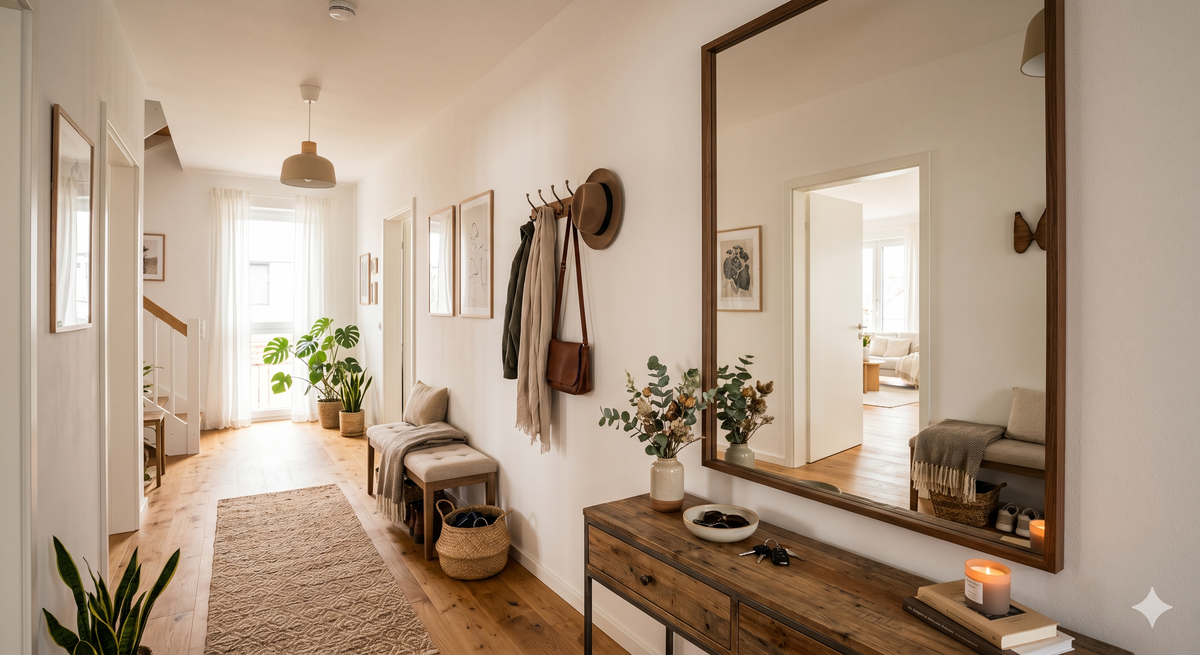
A large mirror in the hallway makes narrow or dark entrance areas look visually wider and brighter because it reflects daylight and artificial light and alters depth perception. Mirrors that cover at least two-thirds of the wall width and are placed opposite or to the side of a light source achieve the greatest effect.
The hallway is the most underrated room in the home; one rarely stays there for longer than 30 seconds, yet it shapes the first impression of the entire home. It is no wonder that "large mirror hallway ideas" is one of the most searched terms related to living. Most guides show pretty Pinterest pictures but do not reveal what really matters when choosing the type of glass, format, and mounting, especially when the mirror is large-format and several kilograms are to hang on the wall.
We fill exactly this gap in this article: seven proven design ideas, combined with the technical background knowledge of a glass specialist company that has been manufacturing in Bavaria since 1857.
Why is a large wall mirror worth it in the hallway at all?
Before moving on to the individual ideas, it is worth taking a look at the physical effect. A mirror does not change a single square meter of floor space, but it does change how the room is perceived.
Light that hits a mirrored surface is not absorbed but redirected. In a hallway without windows – and this applies to the majority of German entrance areas – a mirror placed opposite the front door practically doubles any light source that enters through the open door or a skylight. This is also the reason why "wall mirror large" as a search term is so closely linked to "hallway" and "small rooms": the visual enlargement demonstrably works better the larger the mirror surface is.
Idea 1: The full-length mirror right next to the front door
A full-length mirror right in the entrance area serves two functions simultaneously: a final outfit check before leaving the apartment and immediate light reflection right at the darkest point of the hallway.
This classic idea works in almost every floor plan. The mounting height is important: the bottom edge of the mirror should end about 20 to 30 cm above the floor so that shoes and trouser hems are also captured without the mirror reaching the floor, which would make it unnecessarily susceptible to impact.
Recommended format: from 1,600 × 500 mm, free-standing or wall-mounted with a concealed mounting.
Idea 2: Mirror wall instead of a single mirror
Anyone with an especially narrow hallway can mirror an entire wall or at least a large section of it instead of hanging a single framed mirror. The result looks more architectural and avoids the "dressing room mirror look."
A mirror wall consists of one or more large-format, edge-polished mirror panels without a frame, which are glued flat onto the wall or mounted with concealed brackets. It is particularly suitable for narrow hallways starting from 90 cm in width.
For surfaces over approximately 1.2 m² or in high-traffic areas, stairwells, apartment buildings, hallways with children or pets, laminated safety glass (LSG) is generally recommended instead of simple mirror glass. More on this in the section on glass types below.
Idea 3: The tilted floor mirror
A leaning, slightly tilted full-length mirror looks more casual and modern than a permanently mounted wall mirror and is particularly suitable for rental apartments where no drill holes should be made in the wall.
What to look out for: Floor mirrors require floor space and a stable base or a wall securing device to prevent tipping, especially if there are children in the household.
Idea 4: Frameless mirror surfaces with polished edges
Frameless mirrors with all-round polished edges look more minimalist and make the hallway appear visually calmer, as no frame visually reduces the size of the mirror surface. However, they require precise edge processing to ensure there is no risk of injury from sharp glass edges.
This look has been trendy for a few years, especially in combination with the "quiet luxury" interior style frequently cited in 2026. Important: A professionally beveled or polished edge is not a visual detail here, but a safety requirement.
Idea 5: Mirror with integrated lighting
Illuminated mirrors, for example with LED backlighting or a narrow light strip along the edge, solve the problem of dark, windowless hallways twice over: they reflect existing light and additionally create their own.
Illuminated wall mirrors combine a mirror panel with integrated LED technology, usually as edge or backlighting. For use in the hallway, warm white light (around 2,700–3,000 Kelvin) is recommended, which appears inviting rather than clinical.
Idea 6: Mirror as a room divider between the hallway and living area
In open floor plans, a large-format mirror can also be used as a semi-transparent partition between the entrance area and the living room, for example standing on a low sideboard or mounted free-standing with glass clamping brackets.
This application is technically closer to a glass construction than a classic wall mirror. Anyone working here with clamping brackets instead of wall mounts should follow the same static principles as with all-glass doors; a free-standing mirror also needs a defined, tested load transfer.
Idea 7: Antique mirror for the vintage look
An antique mirror has a deliberately irregular, slightly stained coating that mimics the look of traditional mirrors from decades past. It goes well with country house style, vintage, and boho furnishings and has more character than a flawlessly clear mirror.
Especially in old buildings or in intentionally nostalgically furnished entrance areas, the antique mirror is the idea that stands out most clearly from the smooth, cool mirror surfaces of the other six concepts.
Which type of glass is suitable for a large hallway mirror?
This is the real difference between a pretty Pinterest idea and a mirror that stays safely on the wall for ten years. Not every type of mirror glass is equally suitable for every format and every location.
|
Glass type |
Feature |
Recommended for |
Buy Now |
|
Mirror (silver) |
Classic, neutral silver mirror |
Standard size, normal residential hallways |
|
|
Bronze mirror |
Warm, bronze-colored tone |
Hallways with warm wood look, loft style |
|
|
Grey mirror |
Muted, smoky reflection tone |
Modern, minimalist interiors |
|
|
Antique mirror |
Vintage look with spot pattern |
Country house style, old building hallways |
|
|
LSG mirror |
Laminated safety glass, shatterproof |
Large formats, stairwells, households with children |
For large-format hallway mirrors from about 1 to 1.2 m² in surface area or in households with children and pets, laminated safety glass (LSG) is the safest choice, as the fragments stick to a tear-resistant film when damaged instead of splintering into sharp edges.
This recommendation is in line with the requirements of the German Social Accident Insurance: Laminated safety glass is explicitly recommended for fall-prevention and high-traffic glazing because fragments stick to the tough-elastic intermediate film and no loose, sharp-edged splinters are created.
Those who want to know more about the production and the differences between single-pane and laminated safety glass can find the technical details in our article on Custom safety glass – toughened or laminated.
What size should a large hallway mirror be?
As a guide: the mirror width should occupy at least 60–70% of the available wall width to achieve the desired room-enlarging effect. In narrow hallway corridors (under 1.2 m wide), portrait-format mirrors starting from 1,500 mm in height are particularly effective.
The exact choice of dimensions naturally depends on the individual floor plan, which is precisely why custom-made production is worthwhile for larger formats instead of a standard format from a furniture store. A custom mirror fills the wall surface with millimeter precision, without annoying gaps at the edge.
How heavy will a large mirror be and how is it mounted safely?
This point is completely omitted in most interior design guides but is crucial: glass has a dead weight of around 2.5 kg per square meter and millimeter of glass thickness. A mirror measuring 1.8 × 0.8 m and 4 mm thick thus already weighs about 14.4 kg, while at 6 mm thickness it is around 21.6 kg.
Wall mirrors up to about 8 kg can usually be mounted yourself on solid walls using standard mirror holders. From about 15 kg, in the case of lightweight or plasterboard walls, and if there is uncertainty about the wall statics, a specialist company should take over the installation.
Anyone planning a larger format should clarify in advance whether the wall can support the weight and rely on a tested mounting, ideally with protection against sliding off, especially in the case of mirrors over seating or wardrobe areas where people sitting or walking underneath would be at risk.
Cutting mirrors yourself or having them manufactured by a specialist?
Some plan to cut a standard mirror to the right size themselves. For small corrections, this may work with the right tools, but with large-format, thicker mirror panels or LSG, this is no longer a DIY task. Those who want to know where the line between feasible self-cutting and necessary professional work lies can find the details in our article Cutting glass – what works and what doesn't.
The base material also plays a role: mirror glass is based on high-quality float glass, the production and properties of which we explain in detail in our basic article What is float glass – the practical guide.
Large mirror hallway ideas: Impact meets glass know-how
A large hallway mirror is one of the most effective and affordable measures to make an entrance area look brighter and more spacious. Which of the seven ideas fits best depends on the individual floor plan, interior design style, and safety requirements – the choice of the right glass type and professional installation are just as crucial as the design idea itself.
As a Bavarian glass specialist since 1857 and with our own toughened/laminated safety glass production since 2011, Adamer provides personal advice on glass type, format, and installation and manufactures every mirror exactly to measure. A non-binding inquiry for a individual custom mirror is possible directly via adamer.de.
Frequently asked questions about large hallway mirrors
How big should a mirror in the hallway be?
As a rule of thumb: at least 60–70% of the wall width, so that the room-enlarging effect becomes visible. In narrow hallways, portrait-format mirrors starting from 1,500 mm in height are particularly effective.
Which mirror color fits best in a dark hallway?
A classic silver mirror reflects light most strongly and neutrally. Bronze or grey mirror glasses are decorative but absorb somewhat more light than a silver mirror.
Do I need safety glass for a large hallway mirror?
From about 1 to 1.2 m² in surface area, in stairwells, or in households with children, laminated safety glass is recommended, as it does not form loose, sharp-edged splinters when broken.
Can I hang a large mirror on the wall myself?
Up to about 8 kg and on a solid wall, self-assembly is usually unproblematic. In the case of higher weight, lightweight walls, or uncertainty regarding statics, a specialist company should take over the assembly.
How much does a custom mirror for the hallway cost?
The costs depend on the type of glass, size, thickness, and edge processing. An individual inquiry with the desired dimensions provides the most accurate offer.


