

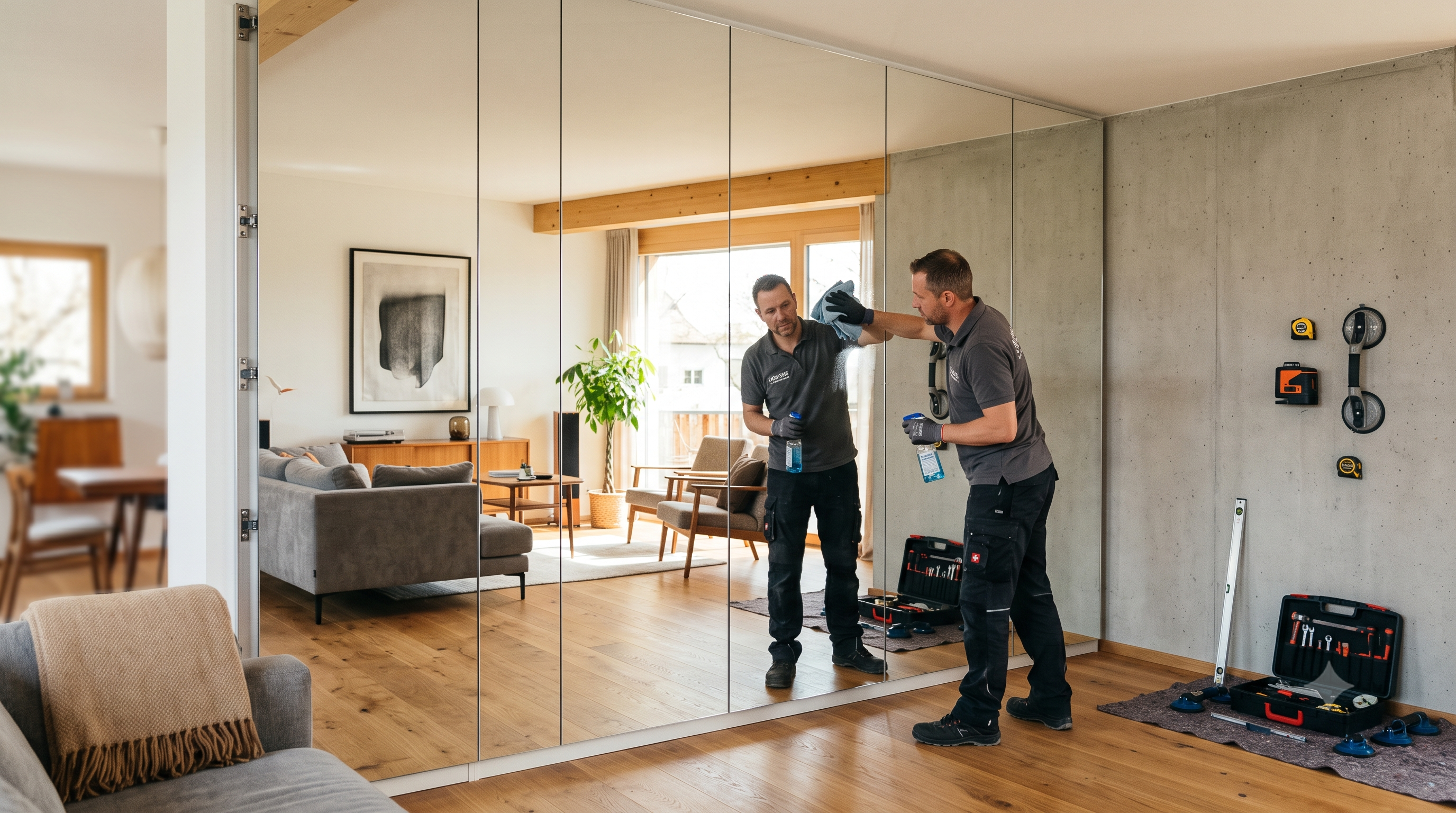
A mirror wall has an immediate effect: rooms become brighter, larger, and more open. This is precisely why it is high on the wish list for hallways, dressing rooms, and, increasingly, home gyms. What most guides fail to mention are the questions that ultimately decide between success and frustration: How heavy will the whole thing be? Which wall can actually support it? And how do you securely mount a mirror wall in a space where people move, train, or dance? As a Bavarian glass specialist with roots dating back to 1857 and in-house ESG/VSG production since 2011, Adamer answers exactly these questions—technically sound and without industry jargon.
What is a mirror wall and what is it suitable for?
A mirror wall is a large, usually floor-to-ceiling mirroring made of one or more custom-cut mirror glass pieces. It is used in living areas, hallways, dressing rooms, and dance and fitness studios where surface area and light effects are particularly important.
Unlike a single wall mirror, a mirror wall usually covers an entire wall surface or at least a large part of it. This is achieved either with a single large-format mirror cut or with multiple elements mounted side-by-side with minimal gaps. Both approaches work, but they differ significantly in weight, installation effort, and cost. Adamer manufactures your mirror wall in-house to the millimeter, ensuring you are not tied to rigid standard sizes.
Fitness mirror wall: What matters in a training room
For a fitness mirror wall, professional installation is paramount. For high-traffic training rooms, Adamer recommends mounting via U-profiles, as these distribute the weight of the mirror wall across the entire edge rather than putting point-specific stress on it.
The home fitness trend is more than a marginal phenomenon: the German fitness industry already counted over 12 million gym members in 2025, or about 13.83 million exercisers if aggregator models are included—a new record (DHFPG). This enthusiasm is increasingly spilling into our own four walls: whether it's a home gym in the garage or a training corner in the basement, for many, a mirror wall is an essential part of the setup because it allows for the monitoring of movements and visually enlarges the space.
For a fitness mirror wall, the choice of a specific glass type plays less of a role than the professional installation. Adamer consciously does not offer laminated safety glass (VSG) for mirrors, as this construction has not proven reliable in practice for mirror glass. In a room where dumbbells, kettlebells, or exercise equipment are moved near the walls, a stable mounting is far more important: mounting via U-profiles distributes the weight of the mirror wall along the entire edge instead of concentrating it on individual small brackets, making it the technically sensible choice for high-traffic movement areas. Additionally, dividing the wall into several smaller elements can help: smaller segments are easier to mount and are more manageable in the event of breakage than a single large surface. Discuss with the Adamer team which glass thickness and mounting method is best suited for your training room.
How heavy is a fitness mirror wall per square meter?
Like all flat glass, mirror glass is a weight factor you should be aware of before planning. As a rule of thumb: one square meter of flat glass weighs about 2.5 kilograms per millimeter of glass thickness. A 6 mm thick mirror therefore weighs about 15 kilograms per square meter. With a mirror wall measuring several square meters, several hundred kilograms can quickly accumulate—a load that the wall and the mounting must be able to support safely. Adamer will advise you in advance on which glass thickness is appropriate for your planned format and whether float glass as base glass is sufficient or customized safety glass is the better choice.
Mirror wall in the hallway: Design ideas and technique
A mirror wall in the hallway makes optimal use of existing light and makes narrow entrance areas appear larger. Silver mirrors are recommended for a neutral, bright look, while bronze and gray mirrors are great for a warmer, dimmed reflection.
In the entrance area, the light effect is what matters most. A bright silver mirror reflects incoming light almost without loss and makes short, dark hallways feel noticeably friendlier. Those who prefer a warmer look should opt for bronze or gray mirrors: both variants slightly dampen the reflection, making them feel less clinical than a classic silver mirror. For particularly decorative accents, an antique mirror with its slightly clouded, aged surface is ideal. Our guide on large-format mirrors in the hallway shows in detail how you can use a mirror wall as part of a larger hallway concept.
A practical tip from our specialist workshop: hallways are often narrow, which makes installing large elements difficult. Instead of one single huge pane, it is often recommended to split it into two or three narrower segments. This reduces the individual weight per element and makes transport through narrow doors and stairwells feasible in the first place.
Mounting a mirror wall: Comparing installation methods
A mirror wall can be glued, mounted with clips, or attached using a combination of both. The choice depends on the weight of the pane, the condition of the wall, and whether the mirror might need to be dismantled later.
The way you mount a mirror wall is a decisive factor for the longevity of the project. Generally, there are three options:
- Gluing: Suitable for small to medium formats on stable, level surfaces. A mirror-compatible adhesive is essential, as unsuitable adhesives can chemically attack the silver layer on the back and cause permanent stains. We have summarized the details on which adhesives are suitable and which are not in our separate article on gluing mirrors.
- Mechanical mounting with clips or rails: The safer choice for larger formats or heavy weight, as the load is transferred mechanically into the wall rather than relying solely on the adhesive surface.
- U-profiles: The glass is hung into a profile at the top and bottom, distributing the load across the entire edge instead of at specific points. This is the standard for large mirror walls, as individual small holders cannot reliably support the heavy weight over the long term.
- Magnetic mounting: For invisible mounting, metal plates are glued to the back of the mirror, with matching strong magnets attached to the wall. This keeps the mirror wall in place without visible brackets; this method is particularly suitable for light to medium-weight formats.
- Combination of gluing and mechanical securing: In practice, this is often the most robust solution, especially for mirror walls consisting of multiple elements.
Professional installation is no accident: the Bundesverband Flachglas (Federal Flat Glass Association) explicitly refers to its own Technical Guideline for the handling and installation of mirrors (Bundesverband Flachglas) in its glazing guidelines—a sign of how seriously the industry takes the topic of load-bearing capacity.
Check the wall structure: Will my wall support the mirror wall?
Not every wall is suitable for heavy glass elements. Solid walls made of brick or concrete usually offer sufficient load-bearing capacity. Caution is advised with drywall or plasterboard walls: here, the load must be transferred into the underlying substructure or load-bearing points using special anchors. If in doubt, have the wall structure checked by a specialist before ordering; especially for larger mirror walls with a total weight of several hundred kilograms, this is not a point where you should cut corners.
Mirror wall comparison: The 4 Adamer mirror types at a glance
All Adamer mirrors are based on high-quality float glass with a reflective silver layer and protective coating on the back. All custom cuts are manufactured with polished edges; Adamer does not offer cut edges without polishing online. Adamer does not offer processing into laminated safety glass (VSG) for mirrors; for rooms with high movement frequency, the appropriate mounting method is recommended instead (see "Mounting a mirror wall" section).
|
Mirror Type |
Visual Effect |
Edge |
Particularly suitable for |
|
Silver mirror |
Neutral, bright, classic |
Polished |
Hallway, living room, classic mirror wall |
|
Bronze mirror |
Warm-toned, dimmed |
Polished |
Hallway, living and dining area |
|
Gray mirror |
Cool-toned, subtle |
Polished |
Living room, modern interior |
|
Antique mirror |
Decorative, slightly clouded |
Polished |
Decorative accents, vintage look |
Your mirror wall from Adamer – expertise in glass since 1857
A mirror wall is more than a decorative element; it is a structural component with real weight and real demands on the wall, installation, and glass type. If you consider this from the start, you will save yourself future frustration and, in the worst case, avoid dangerous situations. Adamer accompanies you from the first measurement to the finished installed mirror wall: with over 150 years of experience in working with glass, in-house ESG/VSG production since 2011, and a range that offers the right solution for every application. Configure your custom mirror directly online or contact our team for a personal consultation regarding your mirror wall.
Frequently asked questions about mirror walls
How heavy is a mirror wall?
The weight depends on the surface area and glass thickness. A guide value is 2.5 kg per square meter per millimeter of glass thickness; a 6 mm silver mirror therefore weighs about 15 kg/m².
Which mirror type is suitable for a fitness mirror wall?
In principle, all four Adamer mirror types are suitable for training rooms. More critical than the mirror type is the professional installation, such as using U-profiles, which safely distribute the weight over the entire edge instead of putting point-specific stress on individual brackets.
Can I glue a mirror wall or do I have to drill?
Both are possible. Gluing is suitable for smaller formats on a stable surface; larger and heavier mirror walls should additionally be mechanically secured, for example via U-profiles or mounting rails.
What is an Adamer mirror made of?
Adamer manufactures mirrors based on float glass with a silver coating and protective varnish on the back, available as silver, bronze, gray, or antique mirrors. Adamer does not offer processing into laminated safety glass (VSG) for mirrors.
Does Adamer also offer cut edges without polishing?
No. All mirrors ordered online from Adamer are manufactured exclusively with polished edges.


