

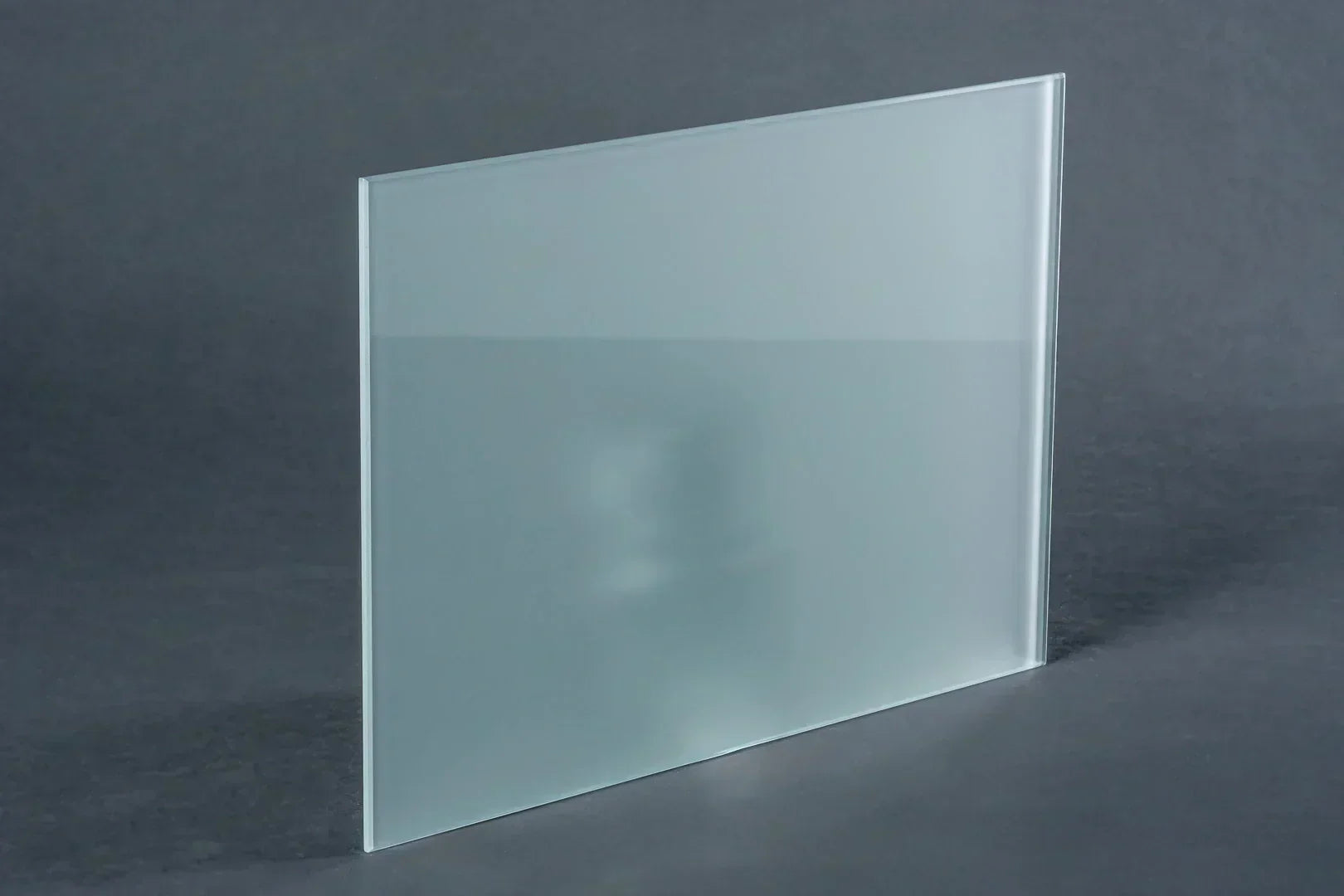
Light yes, views no – that is the promise that satin glass has kept for decades. Anyone today faced with the decision of whether milk glass or satin glass is the right choice for a bathroom, office, or living space will quickly encounter a multitude of terms and half-baked answers. This guide clears things up: what exactly is satin glass, how is it made, what properties does it have, and when is the combination with safety glass not just sensible, but mandatory? As a Bavarian glass specialist with roots dating back to 1857 and in-house ESG/VSG production since 2011, Christian Adamer GmbH knows what really matters when it comes to choosing the right glass.
What is satin glass?
Satin glass is a translucent but opaque flat glass whose surface is matted by chemical etching or mechanical sandblasting. It allows light to be diffused without enabling a clear view.
Before discussing manufacturing processes, care tips, and regulatory standards, it is worth taking a clear look at the essentials: what exactly lies behind the term satin glass, and why is it so frequently confused with other types of glass?
Satin glass is a translucent clear glass that receives a matte surface through chemical or mechanical processing. It is characterized by opacity while maintaining high light transmission, providing soft, uniform light diffusion. The term is derived from the French word satiner, meaning "to smooth" or "to polish," and describes a surface treatment that creates a velvety, non-glossy texture.
The base glass is usually float glass, the flat glass produced via the float process that forms the standard for almost all glass processing. Those who want to learn more about the production of float glass will find a sound foundation in our article What is float glass – The practical guide for your project. Satin glass is therefore not a standalone glass type, but a surface treatment that turns clear flat glass into a visually and functionally entirely new material.
How is satin glass manufactured?
The matting effect is not achieved through a special raw material, but through the targeted processing of the glass surface. According to BauNetz Wissen, matte etching is primarily used in architecture to create satin surfaces, which often serve as privacy glass due to their opacity. Several processes have become established in industrial practice, which differ significantly in surface quality, maintenance properties, and suitability for application.
Acid etching: the industry standard
In acid etching, hydrofluoric acid acts on the glass surface in a controlled manner, creating a uniformly matte, smooth texture. This process delivers the easiest-to-maintain and highest-quality form of satin glass; it is also the process Adamer uses for its float-based satin glass. The depth and appearance of the matting can be precisely controlled through the concentration and exposure time of the acid.
In the industrial production process, the acids used are completely neutralized and removed after treatment, making the finished glass surface safe for daily use. The processing itself requires strict safety precautions and should be carried out exclusively by specialist companies.
Sandblasting: flexible for patterns and partial matting
With sandblasting, the glass surface is mechanically roughened with abrasive corundum under high pressure, creating a rough, matte surface. By using stencils, individual patterns, logos, or motifs can be applied specifically—a clear advantage over acid etching, which is optimized for large-scale, homogeneous matting.
However, sandblasted glass is more coarse-pored and susceptible to fingerprints than acid-etched glass and is therefore less suitable for large-scale wet room applications.
Overview of other processes
- Film matting: Especially for laminated safety glass (VSG), a satin film is inserted between the glass layers; the advantage: both sides remain smooth and easy to clean.
- Screen printing: Ink is applied via a screen and baked on during the tempering process; easier to clean than etched glass, but less durably matted.
- Roller embossing: The glass is passed between patterned rollers, particularly suitable for large-scale applications.
- Laser engraving: A laser beam processes the surface precisely, ideal for fine patterns or lettering.
Light transmission of satin glass
How much light satin glass transmits depends crucially on the degree of satinization and the glass thickness. This parameter should be included in the planning from the very beginning. Typically, light transmission is between 40% and 85%:
- Fine satinization (70–85%): The glass remains relatively translucent, ideal for offices and living spaces where plenty of daylight is desired but privacy is required. According to the Federal Association of Flat Glass (Bundesverband Flachglas), light transmission is one of the most important selection criteria for interior glazing.
- Strong satinization (40–70%): More intensive matting with significantly reduced light transmission, ideal for bathrooms, meeting rooms, and areas with high privacy requirements.
- Double-sided satinization: Further increases matting and privacy, but reduces light transmission further.
- Partial satinization: Combination of matte and clear areas, targeted control of light and privacy for decorative applications.
Tip: For rooms requiring high daylight levels while desiring privacy, a fine satinization is recommended. It offers the best compromise between brightness and seclusion.
Overview of satin glass properties
Anyone who wants to use satin glass in a targeted manner should be familiar with its property profile, as the decision does not depend on appearance alone.
- Translucency instead of transparency: Satin glass is translucent but not transparent. Outlines and colors are vaguely recognizable, details remain hidden. Important: Privacy is not 100 percent; with strong interior lighting, people can be seen in outline.
- Soft light diffusion: The matte surface diffuses incident light evenly and glare-free – ideal for rooms that should appear bright but not harsh.
- Easy-care surface (acid-etched): Acid-etched glass is more resistant to fingerprints than sandblasted glass because the surface is more uniform and less porous.
- Energy efficiency: Satin glass reduces direct sunlight and thus the need for air conditioning, while at the same time allowing enough natural light into the room to minimize artificial lighting.
- Optional enhanced scratch resistance: Scratch resistance is not an automatic property of satin glass but requires a separate additional treatment. Anyone using satin glass in high-traffic areas should specifically request this option from the specialist company.
- Durability: With proper care, satin glass does not change color or light transmission over its service life.
What types of satin glass are available?
Satin glass is not just satin glass; depending on the base glass, depth of processing, and desired look, various versions are available. Adamer carries two variants in its range:
- Float-based satin glass: The standard version with a classic matte-milky surface, produced using the etching process. Ideal for showers, office doors, partition walls, and furniture. Available from 4 mm thickness, optionally with cut edges or polished edges.
- Extra-white satin glass: The low-iron version based on white glass. Particularly neutral, clear white appearance without the slight green tint of standard float glass; the first choice wherever color fidelity and a particularly high-quality look are at the forefront, e.g., in museum glazing, shop fitting, or sophisticated interior design projects.
- Pattern-satinized: Partial matting creates decorative patterns, stripes, or motifs. Often used for glass doors and partition walls.
- Color-satinized: Glass tinting before satinization or subsequent colored coating for modern interior design.
- Single-sided satinized: Standard for most applications, one side matte, one side clear.
- Double-sided satinized: Increased matting and more complete privacy, e.g., for doctor's offices, hospitals, or meeting rooms.
- Anti-fingerprint coating: Special coating that significantly reduces susceptibility to fingerprints; recommended for high-traffic areas.
- Satin ESG or VSG: For all safety-relevant applications, more on this in the next section.
Satin glass vs. milk glass: What is the difference?
This question regularly causes confusion in consulting practice because both terms are often used synonymously in everyday life. Technically, however, they involve fundamentally different manufacturing methods.
As Wikipedia explains, milk glass is created in two fundamentally different ways: either opacifiers such as calcium phosphate, fluorides, or tin oxide are added to the glass mixture before melting so that the glass is opaque throughout, or it is produced as "flashed milk glass," where clear float glass is fused with a thin layer of opalescent glass during the production process. The milk glass (OPALIKA®) carried by Adamer as special glass is a two-layer glass developed primarily for demanding lighting applications such as light ceilings in museums, showrooms, and atriums; it diffuses light evenly with minimal shadows but is not a privacy glass in the classic sense.
Satin glass, on the other hand, is created through a subsequent surface treatment of finished clear glass and is the right choice for all applications where privacy combined with light transmission is required.
|
Feature |
Satin glass (acid-etched) |
Sandblasted glass |
Milk glass |
|
Origin |
Subsequent surface matting |
Subsequent surface matting |
Opacifiers in the glass mass or flashed glass |
|
Surface |
Fine, uniform, silky |
Rough, more coarse-pored |
Smooth, uniformly milky |
|
Susceptibility to fingerprints |
Low |
High |
Low |
|
Maintenance effort |
Low |
Higher |
Low |
|
Light transmission |
40–85%, diffuse |
40–85%, diffuse |
Medium to high |
|
Individual patterns |
Limited |
Very possible |
Not possible |
|
Costs |
Medium to higher |
Medium |
Cheaper |
|
Typical application |
Showers, office doors, partition walls |
Decorative elements, patterned glazing |
Windows, doors, special lighting |
Advantages and disadvantages of satin glass
Satin glass impresses in many areas, but like any material, it has strengths and limitations that should be known before making a purchase decision. Anyone who knows both sides makes an informed choice and avoids costly planning errors that cannot be corrected retroactively in the case of satin ESG.
Advantages
- Modern, high-quality appearance with a velvety feel
- Effective privacy with simultaneously high light transmission
- Uniform, glare-free light diffusion, no darkened rooms
- Diverse design possibilities: patterns, colors, partial matting
- Easy to maintain (especially the acid-etched version)
- Durable and safely usable in combination with ESG/VSG
- Contribution to energy efficiency by reducing direct sunlight
- 100% recyclable
Disadvantages
- More expensive than clear glass and simple milk glass
- Matting cannot be changed or removed later
- For ESG: all dimensions, drill holes, and cutouts must be determined before tempering
- Sandblasted versions more susceptible to fingerprints and limescale
- Scratch resistance not automatically present, requires additional treatment
- Privacy not 100 percent with strong interior lighting
- For exterior applications, a protective sealant is recommended
Satin glass as ESG or VSG: When is safety glass mandatory?
Satin glass must be executed as ESG (tempered safety glass) or VSG (laminated safety glass) in showers, glass partition walls, and walk-through areas. The matting is applied to the base glass before it undergoes the safety process.
Satin glass as plain float glass is not permitted in numerous application areas. As soon as a glass pane is used in a safety-relevant area, building regulations and technical standards dictate safety glass. The relevant standards are DIN EN 12150 for single-pane safety glass (ESG) and DIN EN 14449 for laminated safety glass (VSG), both issued by the German Institute for Standardization. Anyone who overlooks this step risks not only official problems but, in the worst case, real risks of injury.
The crucial planning step: For single-pane safety glass, all processing—cutting, grinding, satinizing, drilling—must occur before the thermal stress process. In this state, it is still simple base glass that can be cut, lasered, sawn, drilled, milled, engraved, and polished. After the pre-stressing process, further mechanical processing is impossible: even drilling a small hole leads to complete glass breakage. The satinization must therefore always take place on the raw float glass; only then is the material tempered into ESG or laminated into VSG. This planning step is regularly underestimated by laypeople.
Adamer Sicherheitsglas has been producing ESG and VSG in its own facilities since 2011 and performs all processing steps before the tempering process. More on this in our guide: Customized safety glass – ESG or VSG.
Typical areas of application for satin safety glass
Satin safety glass is found today in almost all areas of modern interior design. The following overview shows where the combination of matting and safety glass is technically necessary or the first choice in terms of design:
- Showers and bathrooms: VSG shower walls made of 2 × 4 mm ESG with 0.76 mm PVB film (= 8.76 mm total thickness), stylish privacy with maximum safety. For a particularly clear, green-tint-free look, the version in extra-white satin glass is recommended.
- Office doors and glass partitions: Privacy-protected, light-flooded workspaces, combinable with VSG sound insulation for meeting rooms upon request.
- Conference rooms and practices: Privacy with natural light conditions, double-sided satinization for complete privacy.
- Storefronts and hotels: Exclusive ambiance with discreet privacy.
- All-glass doors and sliding elements: ESG is mandatory for all walkable glass elements. More on the versatile application areas of flat glass.
- Furniture, tabletops, display cases: Satin float glass without safety requirements; for tabletops from 6 mm, satin side down.
- Stairwells, railings, overhead glazing: Exceptionally mandatory VSG area; the PVB film holds fragments together and prevents the danger of falling. For areas with additional fire protection requirements, wired glass offers a classic alternative, which is held together upon breakage by its embedded wire mesh.
Costs of custom satin glass
The price of satin glass depends on several factors. Planning early avoids unnecessary additional costs, especially since subsequent changes are simply not possible with toughened safety glass (ESG).
The most important price drivers:
- Glass thickness: 4 mm satin float glass is significantly cheaper than 10 mm satin ESG
- Format: Larger surfaces and special formats increase the price
- Level of processing: Float < ESG < laminated safety glass (VSG); each step means more safety, but also higher costs
- Base glass: Standard float base is cheaper than low-iron white glass (extra-white)
- Satin finishing process: Acid etching is generally more expensive than sandblasting but offers better maintenance properties
- Edge processing: Polished edges cost more than cut edges
- Drill holes and cutouts: Additional line items in the calculation
For guidance: Satin ESG starts at approx. 80–200 euros per m²; VSG versions from approx. 200 euros per m². For a reliable calculation, we recommend an individual inquiry directly via adamer. You can learn more about the limits of glass processing in our guide, Cutting glass – what works and what doesn't.
Maintaining satin glass correctly
Satin glass should be cleaned with a microfiber cloth and a mild glass cleaner. Abrasives, steel wool, and aggressive cleaners are taboo; they permanently destroy the matte structure.
- Clean over a large area and with moisture: Never clean locally; always clean over a large area with moisture to prevent scratches from dirt particles.
- Gentle cleaning agents: Mild alcohol-based glass cleaners or a vinegar-water solution (1 part vinegar, 3 parts water) have proven effective.
- Soft cloth: Use only soft, lint-free microfiber cloths or cotton cloths; no paper towels.
- Rinse and wipe dry: After cleaning, rinse with clear water and wipe dry immediately to avoid water spots.
For damp room applications such as showers, an anti-fingerprint coating or nano-sealing is additionally recommended. If you use satin glass on furniture or tabletops, the satin side should face inward; the smooth clear glass side is much easier to care for in everyday use.
Custom-made satin glass: What you should pay attention to when ordering
Anyone ordering custom-made satin glass faces a series of technical decisions that significantly influence the final result. Glass thickness, level of processing, and edge finishing are not details that should be left to chance, especially when the glass is installed in safety-relevant areas.
The following parameters should be determined before ordering:
- Glass thickness: 4 mm (simple partition walls, furniture) to 12 mm (tabletops, load-bearing elements)
- Base glass: Standard float base (satin glass) or low-iron white glass (satin glass extra-white) for particularly neutral color rendering
- Single-sided or double-sided satin: Single-sided is standard; double-sided increases privacy and reduces light transmission
- Level of processing: Float glass, ESG, or VSG; always clarify with the specialist company first
- Edge processing: Cut edge or polished edge; raw cut edges are prone to breakage
- Tolerances: Consider a ±1 mm manufacturing tolerance when planning frames and fittings
- Anti-fingerprint coating: Recommended for high-traffic areas or damp room applications
What is satin glass? The most important points at a glance
Once you understand how satin glass is made and in what contexts it requires what depth of processing, you quickly recognize that it is a material that uniquely combines functional precision and design elegance. However, only those who consider manufacturing processes, safety requirements, and the installation situation from the very beginning will make the right decision.
Satin glass combines things that rarely go together: sophisticated aesthetics, functional privacy, and, in the right version, technical safety reliability. What is satin glass in the end? A versatile material that only unfolds its full potential when planned, processed, and installed professionally.
Adamer Sicherheitsglas advises you from the choice of material to custom manufacturing, with craftsmanship experience since 1857 and our own safety glass production since 2011. Configure your satin glass on float base or satin glass extra-white directly now, or get in touch for individual advice.
Frequently asked questions about satin glass
What are the disadvantages of satin glass?
Satin glass is more expensive to purchase than clear glass and, depending on the process, more susceptible to fingerprints and limescale. The matte finish cannot be subsequently removed or altered. In addition, processing after hardening (in the case of ESG) is no longer possible; dimensions and cutouts must be planned exactly in advance.
What does satin glass look like?
Satin glass has a matte, slightly velvety surface and appears milky white. It allows light to shine through diffusely without allowing a clear view; outlines and colors are recognizable in schematic form, while details remain hidden. The surface appears more elegant and uniform than sandblasted glass.
How do you clean satin glass?
Best with a soft microfiber cloth and a mild glass cleaner or lukewarm water with a splash of vinegar, always over a large area and without strong pressure. Scouring pads, steel wool, and aggressive cleaning agents are taboo as they permanently damage the matte structure.
How much light does satin glass block?
Satin glass is translucent but not transparent. It scatters incoming light evenly and softly without blocking it completely. Depending on the degree of satin finish and glass thickness, the light transmission is typically between 40 and 85%; a fine satin finish allows significantly more light to pass through than a strong, completely opaque matte finish. Therefore, it does not create dark rooms, but rather pleasantly illuminated surfaces with reduced visibility.


