

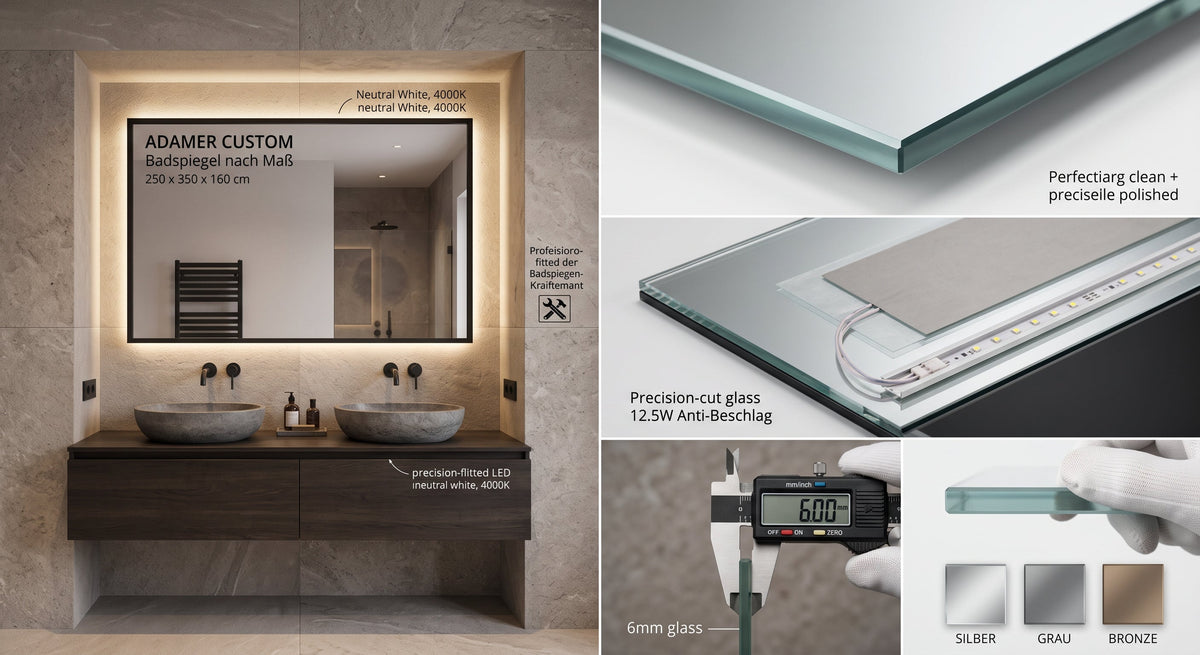
A standard mirror from a furniture store rarely fits perfectly. It is either too wide for the niche above the vanity, too narrow for the wall next to it, or it simply ends in the wrong place. A custom-made bathroom mirror solves exactly this problem: It is cut precisely to your desired dimensions, instead of you having to adapt your bathroom to fit a standard format.
What most guides fail to provide is an honest answer to three questions: What glass thickness does your size really require, what is actually electrically permitted regarding lighting and outlets, and which features are just marketing promises rather than real options? This guide fills exactly that gap with the technical background knowledge of a Bavarian glass specialist company that has been manufacturing since 1857 and has operated its own ESG and VSG production since 2011.
What is a custom-made bathroom mirror and when is it worth it?
Short answer: A custom-made bathroom mirror is a mirror that is individually cut to a specific installation situation in terms of width, height, and edge finish, rather than coming from a fixed range of standard sizes. It is always worth it when niches, slanted ceilings, a floor-to-ceiling vanity, or a wall full of outlets make a generic, rectangular format impractical.
According to a study by the Association of the German Sanitary Industry (Vereinigung Deutsche Sanitärwirtschaft), 94 percent of German bathrooms already have a mirror or mirror cabinet (Source: baustoffwissen.de), making the mirror one of the few items that practically every bathroom possesses. This is precisely why it is worth looking at the details during a renovation: A precisely cut mirror looks higher quality than a mass-produced product with gaps at the edges.
What types of mirrors are available for a custom-made bathroom mirror?
There are four types of mirror glass to choose from for a custom-made bathroom mirror: the classic silver mirror, bronze mirror, and grey mirror as tinted variants, as well as the decorative antique mirror with a patina look. All four are manufactured with polished edges.
Each variant reflects differently and suits a different interior style. The silver mirror remains the all-rounder for a neutral, color-accurate reflection. Tinted mirrors like bronze or grey subtly dampen the reflection and suit modern, minimalist bathrooms. The antique mirror, on the other hand, is intended as a unique piece, with an irregular spotted pattern for country-house or vintage bathrooms, acting more as a decorative wall element above a shelf than as a shaving mirror directly at the vanity.
|
Mirror type |
Reflection character |
Available thicknesses |
Ideal for |
Product page |
|
Mirror (silver) |
Neutral, color-accurate, brightest |
3, 4, 5, 6, 8 mm |
Standard bathroom mirror, vanity mirror |
|
|
Bronze mirror |
Warm, gold-brown tint |
4, 6 mm |
Classic, sophisticated bathrooms |
|
|
Grey mirror |
Cool, subdued, modern |
4, 6 mm |
Minimalist, modern bathrooms |
|
|
Antique mirror |
Patina look, unique character |
4 mm |
Decorative accent, country-house style |
A detailed explanation of how glass types generally differ can be found in our fundamental article What is float glass – the practical guide, as mirror glass is always based on high-quality float glass coated on the back. The technical definition of mirror glass is also clearly described in the technical glossary from BauNetz Wissen.
What glass thickness does a custom-made bathroom mirror require?
For custom-made bathroom mirrors, a thickness of 4 to 5 mm is usually sufficient. Only for surfaces of about 1 square meter or more, or for free-standing models, is 6 to 8 mm worth considering, due to higher stability and because thicker glass is less prone to bending.
Thinner 3 mm glass is intended for small mirror surfaces embedded in furniture, not for free-hanging wall mirrors in the bathroom. The rule of thumb: The larger the surface area, the more thickness it needs to remain flat during transport and on the wall.
Weight is directly related to this, which is completely ignored by most interior design guides. Glass weighs about 2.5 kilograms per square meter per millimeter of glass thickness. A bathroom mirror measuring 80 × 120 cm (0.96 m²) with a thickness of 4 mm already weighs about 9.6 kg, and at 6 mm about 14.4 kg. How this is calculated for your specific format, including special cases for laminated glass with PVB film, is explained in detail in our calculation example article Calculating glass weight – formula, table, and practical examples.
|
Format |
Surface area |
Weight at 4 mm |
Weight at 6 mm |
|
60 × 80 cm |
0.48 m² |
approx. 4.8 kg |
approx. 7.2 kg |
|
80 × 120 cm |
0.96 m² |
approx. 9.6 kg |
approx. 14.4 kg |
|
100 × 150 cm |
1.50 m² |
approx. 15.0 kg |
approx. 22.5 kg |
Custom-made bathroom mirror with lighting: What is actually possible?
Adamer supplies custom-cut mirror glass with polished edges, not pre-integrated LED frames or touch sensors. For anti-fog functionality, there is a separate, TÜV and CE-certified accessory: the mirror heater, which is mounted on the back of the mirror.
"Bathroom mirror with lighting" is one of the most searched terms related to this topic, and many shops advertise touch dimmers, Bluetooth speakers, and weather stations in the frame. Honestly: These are nice extras, but they have little to do with the actual craft of precise glass cutting. As a specialized glass company, Adamer focuses on what we truly master: millimeter-precise cutting and polished edges, supplemented by certified accessories such as the mirror heater. This warms the back of the mirror to about 28 degrees in 3 to 5 minutes using 12.5 watts and can be connected directly to the existing bathroom lighting or a separate switch without a transformer.
Important note: Electricity in the bathroom is subject to strict protection zones. According to DIN VDE 0100-701, switches, outlets, and mirror cabinets with integrated outlets are generally prohibited in the water-adjacent protection zones 0 to 2 (Source: BauNetz Wissen); outside these zones, an RCD (residual current device) with a maximum of 30 mA is mandatory (Source: ELEKTRO+). Anyone looking to retrofit a mirror heater or LED lighting should therefore have the connection planned by a qualified electrician, rather than deciding based on aesthetics.
One more word on light color, because it is more often underestimated than wattage: According to the German Energy Agency (dena), LED bulbs save between 60 and 90 percent of energy compared to classic incandescent lamps (Source: dena via enercity.de), which adds up significantly over the years for a light source used multiple times daily, like a bathroom mirror. Neutral white light around 4,000 Kelvin is closest to daylight and is best suited for makeup or shaving.
Polished edge or beveled edge: What does Adamer really offer?
All mirrors from Adamer are manufactured exclusively with polished edges. We do not currently offer beveled edges online.
Many competitors list "beveled edge" as an option in their configurators, especially with search terms like "mirror beveled edge" having significant search volume. At Adamer, you consistently get polished edges—cleanly beveled and evenly smooth. This is not a compromise, but a conscious decision for a finish that suits clear, unadorned bathrooms and can be easily mounted with clips or tilt-mirror holders. Anyone specifically seeking a decorative beveled edge should clarify this with our team before ordering.
How do you safely mount a custom-made bathroom mirror?
For mirrors weighing up to about 8 kg, custom-made bathroom mirrors can usually be installed by yourself on a solid wall using mirror clips or a tilt-mirror holder. For heavier weights, drywall, or if you are uncertain about load-bearing capacity, a specialist should handle the installation.
Slippery tiles, humidity, and a heavy mirror above the sink are not a good combination. According to the Federal Institute for Occupational Safety and Health, about 250,000 accidents occur annually in German bathrooms (Source: wannentueren.de), one more argument for not improvising during installation.
For the attachment itself, we recommend mechanical solutions such as mirror clips or a tilt-mirror holder. Both are available in our accessory range and can be easily mounted on load-bearing walls. We advise against using adhesive-only mounting: Adhesives react differently depending on the mirror coating, substrate, and ambient humidity, and an unsuitable combination can impair adhesion over time. A mechanical fastening is the reliable choice here, especially above a vanity, where people could be standing underneath in the event of breakage.
Unlike large-format mirror walls or hallway mirrors in high-traffic areas, we do not rely on laminated safety glass for classic custom-made bathroom mirrors. At Adamer, we generally do not offer the processing of mirror glass into VSG (laminated safety glass); the bond between the mirror coating and the PVB film does not hold reliably in practice. For private bathroom mirrors, we rely instead on the appropriate glass thickness and professional mechanical mounting. You can read more about the distinction between tempered safety glass (ESG) and laminated safety glass (VSG) in our fundamental article What is safety glass? ESG, VSG, and standards at a glance. The ift Rosenheim also shows how testing institutes generally test glass for stability and safety in its testing laboratory overview.
How to keep your custom-made bathroom mirror streak-free
The best way to clean custom-made bathroom mirrors is with a soft, lint-free microfiber cloth and a streak-free glass cleaner, without using abrasive sponges or harsh household cleaners.
Limescale stains, toothpaste splatters, and condensation are everyday occurrences in the bathroom, and this is exactly what damages the coating on the back of the mirror in the long term if water penetrates the edges. A detailed step-by-step guide including the most common mistakes can be found in our guide Cleaning glass without streaks – the great expert guide.
What does a custom-made bathroom mirror cost?
The price of a custom-made bathroom mirror depends on the glass type, thickness, surface area, and desired accessories. A reliable figure is only provided by the individual calculation in the configurator with your desired dimensions.
A study commissioned by Hansgrohe shows that almost every second German (46 percent) perceives their bathroom as outdated and plans an average of around 9,200 euros for a bathroom renovation (Source: haustec.de). The mirror is rarely the most expensive item, but it is often the point where a custom-made product makes the biggest visual difference. Simply select your mirror type, enter the width and height, and the exact price will appear directly in the configurator.
Custom-made bathroom mirror: Precision that fits your bathroom
A custom-made bathroom mirror is not a luxury, but the logical solution for every bathroom that does not have catalog dimensions—and that applies to most bathrooms. Ultimately, three things are decisive: the right glass type for your interior style, a thickness that suits the surface area, and an installation that remains secure even in five years. As a Bavarian glass specialist since 1857, with our own ESG and VSG production since 2011, Adamer provides personal advice on glass type, format, and mounting, and manufactures every custom-made bathroom mirror exactly to your desired dimensions. Configure your mirror directly in the shop, or contact our team if you have individual questions about special formats.
Frequently asked questions about custom-made bathroom mirrors
How large can a custom-made bathroom mirror be?
The maximum size depends on the glass type and thickness. For very large formats, an individual inquiry is recommended so that transport and wall statics are considered from the beginning.
Do I need laminated safety glass for a custom-made bathroom mirror?
No. For a classic bathroom mirror above a vanity, the appropriate thickness in combination with professional mechanical mounting is sufficient. Adamer does not generally offer VSG mirrors.
Can I cut a custom-made bathroom mirror to size myself?
For small corrections with the right tools, yes; for larger or thicker formats, it quickly becomes risky. You can read details about the boundary between DIY cutting and professional service in our article Cutting glass – what works and what doesn't.
Is a custom-made bathroom mirror suitable for damp rooms?
Mirror glass itself handles normal bathroom humidity without any problems. The decisive factor is adequate ventilation and an installation where water does not permanently sit on the edges.
How long does it take to manufacture a custom-made bathroom mirror?
The exact delivery time depends on the glass type and accessories and is displayed directly during the order process in the configurator.


