

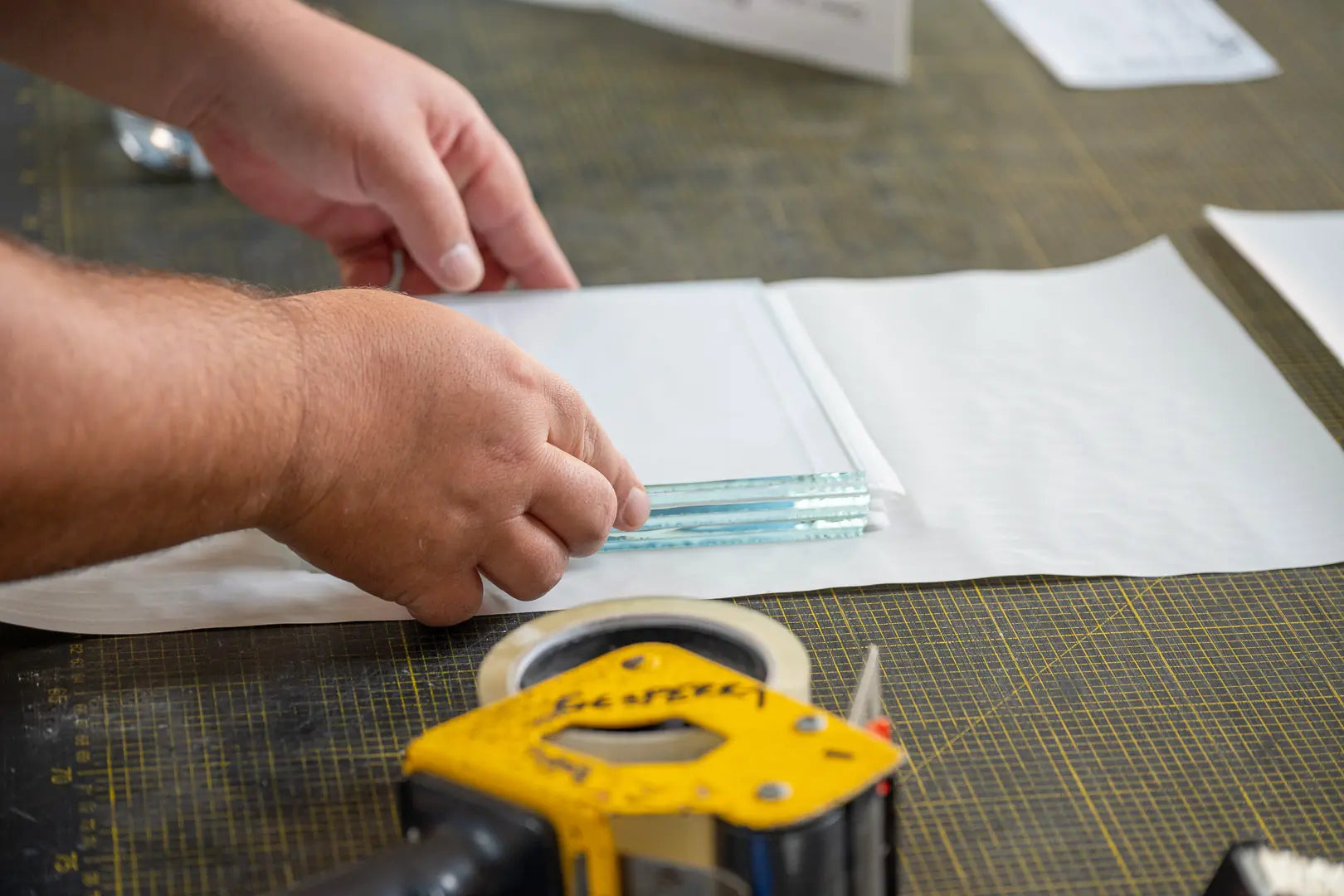
Glass appears light and transparent, but it is surprisingly heavy. Anyone planning a glass panel, mirror, or pane for a conservatory cannot avoid a clean calculation of the glass weight. In this guide, we will show you the exact formula for calculating glass weight, a practical table based on glass thickness, and points that almost every other guide overlooks: how much weight you are actually allowed to carry alone, and when does a simple calculation become a case for a structural engineer?
How is the weight of glass calculated?
Glass has a density of 2.5 g/cm³. The correct formula is: 2.5 kg/mm per m². To calculate the weight, multiply length (m) × width (m) × thickness (mm) × 2.5. The result is the weight in kilograms.
Calculating glass weight: The formula at a glance
The formula for the calculation is simpler than many think. You only need three values: length, width, and thickness of the pane. The correct formula is: 2.5 kg/mm per m², which is the glass density converted to area and thickness.
Formula: Weight (kg) = length (m) × width (m) × thickness (mm) × 2.5
If you prefer calculating in millimeters, use this version:
Formula (mm): Weight (kg) = length (mm) × width (mm) × thickness (mm) × 0.0000025
Both formulas lead to the same result; only the units differ.
Example calculation: A pane with a length of 1.20 m, a width of 0.80 m, and a thickness of 6 mm weighs: 1.20 × 0.80 × 6 × 2.5 = 14.4 kg
This rule of thumb applies directly to float glass and TSG (toughened safety glass). For LSG (laminated safety glass), in addition to the total thickness of all glass panes, you also add the thickness of the foil(s), which you would normally estimate at 0.38 mm or 0.76 mm. Read more about the differences between glass types in our guide Custom-made safety glass: TSG or LSG.
Calculating the weight of glass: The physical principles
To ensure the formula doesn't feel like rote-learned mathematics, it is worth taking a look at the physics behind it.
Why exactly 2.5 g/cm³?
Glass essentially consists of quartz sand, soda, and lime, which are fused into a homogeneous mass at around 1,550 to 1,600 °C. This material combination results in a density of about 2.5 g/cm³, which corresponds to 2,500 kg per cubic meter. For comparison: water has a density of 1 g/cm³, so glass is about two and a half times heavier than the same amount of water. This density applies to almost all standard construction glasses, including float glass, as confirmed by the technical article on float glass on BauNetz Wissen.
What does this mean for practice?
It follows from the density that: Every square meter of glass weighs 2.5 kilograms per millimeter of thickness. If you double the thickness, the weight also doubles, regardless of glass color or processing. Whether clear glass, satin glass, or antique mirrors: the density remains almost the same, as long as no heavy additional layers such as laminated foils or coatings are added.
Glass weight table: Weight per square meter by thickness
This table shows the weight per square meter for common standard thicknesses, as they are also manufactured to size at Adamer.
|
Glass thickness (mm) |
Weight per m² (kg) |
Typical application |
|
2 mm |
5.0 kg |
Thin glass, small furniture inserts |
|
3 mm |
7.5 kg |
Picture frames, small display cases |
|
4 mm |
10.0 kg |
Furniture glass, mirror glass, shelves |
|
5 mm |
12.5 kg |
Medium window glass inserts |
|
6 mm |
15.0 kg |
Tabletops (medium size), door panels |
|
8 mm |
20.0 kg |
Larger tabletops, aquariums |
|
10 mm |
25.0 kg |
Large-area tabletops, TSG applications |
|
12 mm |
30.0 kg |
Structural glazing, all-glass doors |
|
15 mm |
37.5 kg |
Heavy constructions |
|
19 mm |
47.5 kg |
Fall protection, custom designs |
These values are net weights of the pure glass. Frames, mounts, or fittings are additional.
Calculating glass weight for TSG and LSG
For safety glass, there is an important addition to the basic formula.
Does safety glass weigh more than normal glass?
TSG weighs the same as float glass of the same thickness because it is the same thermally toughened base glass. For LSG, the total thickness of all glass panes plus the thickness of the intermediate foil, usually 0.38 mm or 0.76 mm, counts.
LSG example calculation
An LSG assembly consisting of two 6 mm panes with a PVB foil in between has a total glass thickness of 12 mm. The foil itself usually has a thickness of 0.38 mm or 0.76 mm and is included in the calculation. With a 0.76 mm foil, the result is:
Total thickness = 12 mm (glass) + 0.76 mm (foil) = 12.76 mm 12.76 mm × 2.5 kg/mm/m² = 31.9 kg per square meter
However, for structural applications such as overhead glazing or fall protection, the simple formula is no longer sufficient; here, structural proof according to DIN 18008 is required. The German Federal Association of Flat Glass (Bundesverband Flachglas) fundamentally revised its guide for glass dimensioning according to DIN 18008 in March 2026, taking into account the current versions of standards from 2024 and 2026, as reported by the trade magazine Glaswelt. Details on the right choice of glass for your project can also be found in our guide Why is safety glass necessary?.
How heavy can a glass pane be to carry?
This is the point that most glass weight calculators on the net completely leave out: the question of safe handling. Anyone who has ever carried a 10 mm pane up the stairs alone knows why this is relevant.
How much glass weight can a person carry safely?
As a rough guideline in Germany, around 23 to 25 kilograms is considered the internationally recommended upper limit for the manual handling of loads by one person. However, there is no fixed legal kilogram limit; the individual risk assessment is decisive.
What occupational safety practice says
After evaluating national and international regulations, a range of 23 to 25 kilograms is recommended as a guideline for lifting and carrying, as a technical assessment by the German Social Accident Insurance Institution for the Construction Industry (BG BAU) shows. Take a look back at the table: A 10 mm pane of one square meter is already exactly at this limit at 25 kg, and a 12 mm pane at 30 kg is significantly above it. From this point on: carry in pairs, work with suction lifters, or commission a specialist company directly.
Incidentally, stricter requirements apply to expectant mothers. According to the Maternity Protection Act, pregnant women may not regularly lift, hold, or carry loads over 5 kg, or occasionally over 10 kg, without mechanical aids, as the Federal Institute for Occupational Safety and Health explains. For 4 mm glass, this corresponds to an area of only half a square meter.
Practical tip: For anything over 20 kg, we generally recommend two people, suitable suction handles, and sturdy protective gloves. You can learn how to safely cut and process glass in our guide Cutting glass: What works and what doesn't.
Correctly assessing glass weight for mirrors, tabletops, and shelves
The formula is always the same, but the requirements differ significantly depending on the area of application.
Mirrors
Mirrors consist of float glass with a silver or aluminum coating on the back. The coating itself is so thin that it hardly affects the weight; the pure glass thickness is sufficient for the calculation. A 4 mm mirror measuring 80 × 60 cm therefore weighs about 4.8 kg, while a large-format mirror measuring 200 × 100 cm with the same thickness already weighs 20 kg.
Tabletops
For tabletops, the supporting surface determines the necessary thickness. Smaller tables often get by with 6 mm, while larger plates or cantilevered areas require 8 to 10 mm or more. A 120 × 80 cm tabletop with 10 mm thickness already weighs 24 kg, a value that many underestimate when buying furniture.
Shelves
For shelves, the glass weight is added to the load of the objects placed on it. A 4 mm shelf with a width of 80 cm is suitable for light decorations; for books or electronics, thicker glass or TSG should be used. Our guide Application areas of flat glass offers a comprehensive overview of typical application areas.
Special case: Heat-resistant glass
For fireplace panes or oven viewing windows made of heat-resistant special glass, the formula also applies in principle, but the density may deviate slightly from the standard value depending on the type of glass-ceramic. Details on material thicknesses and weight for these special applications can be found in our guide Heat-resistant glass: The ultimate buying guide.
Avoiding common mistakes when calculating glass weight
- Wrong unit used: If the thickness is entered in centimeters instead of millimeters, the result shifts by a factor of 10. Always calculate in millimeters.
- Forgetting frame or fitting weight: The formula only provides the pure glass weight. Aluminum frames, mounts, or fittings are additional.
- LSG thicknesses not fully added: For laminated glass, the total thickness of all glass panes plus the thickness of the intermediate foil (usually 0.38 mm or 0.76 mm) counts, not just the pure glass thickness.
- Ignored load-bearing capacity of the wall or construction: Even a correctly calculated glass weight is useless if dowels, the wall, or the substructure are not designed for it.
- Underestimated transport risks: Especially for large-format panes over 20 kg, it is worth looking at occupational safety regulations before moving the pane alone.
Our guide Flat glass production: How modern flat glass is produced explains how modern flat glass is manufactured industrially and why the thickness is precisely controlled during production.
Calculating glass weight made easy
With the formula length × width × thickness × 2.5, the weight of any glass pane can be calculated in a few seconds, without any online calculator. More important than the number itself is how you handle it: from which thickness you need help, when a structural calculation according to DIN 18008 is necessary, and which type of glass is suitable for your project. At Adamer, we manufacture float glass, TSG, LSG, and mirrors to the millimeter, including personal advice on the appropriate glass thickness for your project. Request custom glass now and receive your individual offer.
Frequently asked questions about calculating glass weight
How is the weight of glass calculated?
Multiply length (m) × width (m) × thickness (mm) by the factor 2.5. The result is the weight in kilograms. For LSG, the added total thickness of all panes counts.
How heavy is one square meter of glass?
One square meter of glass weighs 2.5 kilograms per millimeter of thickness. A 6 mm glass therefore weighs 15 kg/m², a 10 mm glass 25 kg/m².
Does LSG weigh more than TSG of the same thickness?
Yes, slightly. For LSG, the total thickness of all glass panes plus the thickness of the intermediate foil, which is usually 0.38 mm or 0.76 mm and is included in the calculation, counts.
From what weight should I no longer carry glass alone?
Around 23 to 25 kg is considered a guideline and the recommended upper limit for manual carrying by one person. From this weight, two people or suction handles are recommended.
Does the glass weight change with heat or cold?
No, the weight remains constant with temperature changes; only the volume expands or contracts minimally. In practice, this effect is negligible for weight calculation.


