

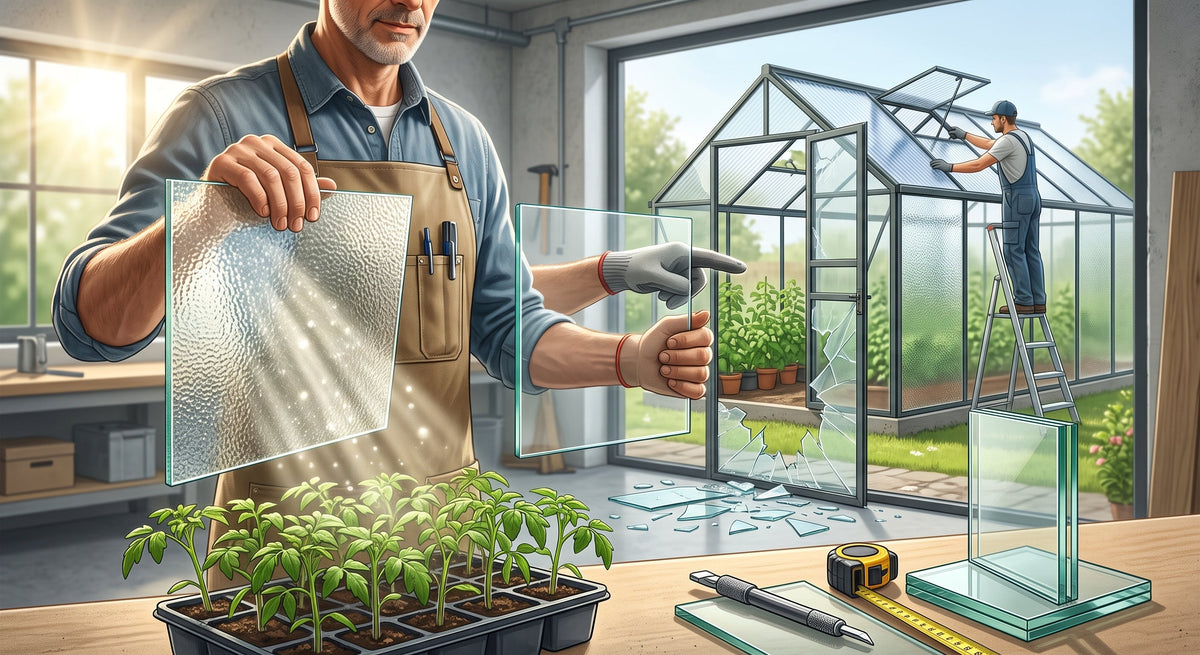
Most guidebooks on greenhouse glass come from people who want to sell you a complete greenhouse. Glass is just one line in the equipment list, right next to polycarbonate and aluminum profiles. We take a different approach: We manufacture the glass, cut it to size, and provide advice precisely when a pane is broken, a DIY project is underway, or a greenhouse manufacturer can no longer supply you with a replacement pane.
This guide answers the questions that other sites omit: What glass thickness does your greenhouse really need, which edge finish do you require, and why is textured glass often the better choice for plants than crystal-clear float glass, even if hardly any greenhouse shop explains why.
The most important points at a glance
- For the walls of small to medium-sized greenhouses, 4 mm float glass or garden glass, which is now also available in 5 mm, is usually sufficient.
- Float and tempered safety glass (ESG) are not approved for roof and overhead areas. Multi-wall sheets, acrylic glass, or alternatively laminated safety glass (VSG) are recommended here.
- Garden glass diffuses light, making it even more beneficial for many crops than crystal-clear float glass.
- ESG cannot be cut after it has been tempered. Dimensions must be finalized before ordering.
- The formula for glass weight is: length (m) × width (m) × thickness (mm) × 2.5 = weight in kg.
What is the best glass for a greenhouse?
For greenhouse walls, float glass or textured garden glass 4 mm or thicker is suitable. In contrast, float and tempered safety glass (ESG) are not approved for roof and overhead areas; multi-wall sheets, acrylic glass, or alternatively laminated safety glass (VSG) are the right choice here. The reason: even though ESG has higher breakage resistance, it may not be used for overhead glazing. For wall areas, however, it offers a clear safety advantage over float glass, as it shatters into blunt-edged granules rather than sharp shards when broken.
Glass for greenhouses: What types of glass are available?
Anyone looking online for glass panes for a greenhouse usually ends up with complete sets that lack technical explanations. In essence, there are only three types of glass suitable for greenhouse construction, and each has a clear area of application; the Federal Association of Flat Glass (Bundesverband Flachglas) provides general background information on flat glass production.
Float glass for greenhouses – the affordable classic
Float glass is crystal clear, distortion-free, and the most economical option for wall surfaces without specific safety requirements. At Adamer, it is available in 2, 3, and 4 mm with a cut edge, each manufactured to the millimeter. The downside: breakage results in sharp-edged shards, which is why it is not a good choice for roof areas or highly exposed locations. If you would like to delve deeper into the manufacturing and properties of float glass, you can find more information in our guide What is float glass?
ESG safety glass: more security for exposed wall surfaces
ESG is created by heating float glass to over 600 °C and then cooling it rapidly, which makes it four to five times more break-resistant. This specific property makes ESG a solid choice for exposed wall areas, such as along paths or near play areas: a hailstone or a falling branch is less likely to result in a dangerous rain of glass. At Adamer, you can obtain clear ESG in 4, 5, 6, 8, 10, or 12 mm, manufactured according to DIN EN 12150 and exclusively with a polished edge. It is important to know: ESG cannot be cut, drilled, or ground after it has been tempered. Dimensions, cutouts, and drill holes must therefore be determined before ordering. You can read more about the production, testing standards, and limitations of ESG in our guide What is ESG glass?
Important: ESG is not approved for roof or overhead glazing at Adamer, nor is float glass. We explain what is used there instead in the next section.
Roof and overhead: Multi-wall sheets, acrylic glass, or VSG instead of float and ESG
Float glass and ESG are not approved by Adamer for glazing the roof or any other overhead surface in a greenhouse. We recommend using multi-wall sheets (polycarbonate) or acrylic glass (Plexiglas) instead: both materials are lightweight, impact-resistant, and specifically suited for use above people and plants. Alternatively, laminated safety glass (VSG) can be used, which, thanks to the embedded PVB film, holds together even if broken and does not fall down in one piece.
Adamer does not carry multi-wall sheets and acrylic glass in its standard assortment, but we are happy to advise you on a custom VSG solution for your overhead glazing. We explain the basic principle of VSG in our guide What is VSG glass?; it is best to discuss individual configurations for your project directly with our team.
Garden glass – textured glass with diffuse light for the wall
This is the actual content gap that most guidebooks miss: Garden glass is a robust textured glass based on float glass that receives a fine, even surface structure through a rolling process. This structure provides pleasant light diffusion and subtle privacy without darkening the interior, making it specifically designed for use in greenhouses, cold frames, and garden buildings. Available in 4 mm thickness, and recently also in 5 mm if additional stability is required, each optionally with a cut edge or a polished edge. Like float glass, garden glass is intended exclusively for wall surfaces, not for roof or overhead glazing.
What many greenhouse guides only casually mention as "pebbled glass" actually has a scientific basis: studies from Wageningen University show that plants respond particularly positively to diffuse, scattered light, while textured greenhouse glass can achieve light transmission values of 91 to 92 percent with light diffusion of 83 to 84 percent, as an expert article in the Austrian gardening magazine Gärtner+Florist, citing Wageningen research, explains.
For crops like tomatoes or lettuce, where even light distribution within the canopy is more important than maximum transparency, garden glass is often the smarter choice than crystal-clear float glass.
Glass or plastic? Greenhouse glass compared to polycarbonate and Plexiglas
Glass offers the highest light transmission and the longest service life; polycarbonate scores points for weight and impact resistance, while Plexiglas falls in between in terms of price and appearance. For wall areas where yield is the focus, glass is usually the better investment. However, for the roof area: float and ESG glass are not approved by Adamer; only multi-wall sheets, acrylic glass, or alternatively VSG are suitable.
|
Feature |
Glass (Float/ESG/Garden) |
Polycarbonate (Multi-wall sheets) |
Plexiglas (Acrylic glass) |
|
Light transmission |
Very high, 85–92 % |
Medium, lower depending on structure |
High, similar to glass |
|
Durability |
Decades, scratch-resistant |
Yellows with UV exposure |
Scratches more easily than glass |
|
Breakage (untreated) |
Sharp shards |
Virtually does not shatter |
Rarely shatters, can crack |
|
Breakage (ESG) |
Blunt-edged granules |
– |
– |
|
Insulation |
Low (single-pane) |
Higher due to air chambers |
Medium |
|
Weight |
High |
Significantly lighter |
Lighter than glass |
|
Optical clarity |
Very high |
Mostly milky/textured |
Very high |
|
Roof/overhead use |
Not approved |
Suitable |
Suitable |
Practical experience shows: with stable aluminum constructions, sheer weight is rarely the problem; it is more the combination of price, light quality, and maintenance effort. For anyone who values distortion-free optics and long durability, there is hardly any alternative to glass for wall areas. However, for roofs and overhead surfaces: only multi-wall sheets, acrylic glass, or VSG are permitted.
What glass thickness does your greenhouse need?
For greenhouse walls, 4 mm is generally sufficient; if additional stability is needed, 5 mm garden glass can be used. Float and ESG glass are generally not approved for roof and overhead areas; multi-wall sheets, acrylic glass, or alternatively VSG are used here. Thickness alone says little about safety; the combination of thickness, glass type, and location is decisive.
Small greenhouse and cold frame: 4 mm is usually sufficient
For small greenhouses and cold frames with manageable spans, 4 mm garden glass or float glass is sufficient for wall areas. For cold frame boxes, which are close to the ground anyway and are rarely subjected to loads from above, float glass with a cut edge is usually the most economical solution. For slightly higher stability requirements, garden glass is now available in 5 mm, with the same edge options as the 4 mm version.
Large greenhouses: walls in glass, roof in multi-wall sheets, acrylic glass, or VSG
For larger greenhouses, a clear division is often worthwhile: wall areas can still be constructed in float glass, garden glass, or ESG, depending on the desired breakage safety. For the roof area, however, the fundamental rule applies: float and ESG glass are not approved at Adamer. Here, you should opt for multi-wall sheets, acrylic glass, or alternatively a custom VSG solution. For larger, self-supporting formats or increased snow loads, it is also worth talking to our team, especially if you are planning VSG glazing for the overhead area.
Ordering replacement panes for a greenhouse: How to proceed
The most reliable way to order replacement panes for a greenhouse is with exact dimensions in millimeters and the appropriate edge processing, directly from the glass manufacturer rather than from the hardware store shelf. This not only saves time but also prevents a pane from failing to fit the profile.
Here is how to proceed:
- Determine dimensions exactly in millimeters, including any rounding or cutouts on the profiles
- Define the glass type: for wall areas without special requirements, usually float glass or garden glass (4 or 5 mm); for walls with increased safety needs, ESG. Float and ESG glass are not approved for roof and overhead surfaces; multi-wall sheets, acrylic glass, or alternatively VSG are recommended here
- Choose edge processing: for float glass and garden glass, cut edge or polished edge; for ESG, the edge is always polished
- For ESG: finalize all dimensions before ordering, as subsequent cutting is not possible
- Allow for delivery time: approx. 5–7 working days for float glass and garden glass, approx. 12–15 working days for ESG due to the tempering process
Anyone unsure whether a damaged pane can still be cut or if a completely new size is necessary will find background information in our guide Cutting glass: What works and what doesn't
Weight and structural integrity: How heavy is greenhouse glass really?
Especially with larger wall areas, the self-weight of glass panes is often underestimated, yet it directly determines the required profile strength of the structure. The formula is simple: length (m) × width (m) × thickness (mm) × 2.5 equals the weight in kilograms. A 4 mm thick pane thus weighs 10 kg per square meter, and a 6 mm thick pane already weighs 15 kg per square meter. With several large-format panes, this quickly adds up to a relevant load for the aluminum profiles. You can find the complete formula, a weight table by thickness, and tips for the safe handling of large panes in our guide Calculating glass weight
Hail, storms, and preserving value: Why safety glass pays off in 2026
Extreme weather is no longer an abstract topic for garden owners. According to the current natural hazards report from the German Insurance Association (GDV), storm, hail, and lightning caused approximately 1.4 billion euros in damages in property insurance in 2025, as the GDV reports in its latest natural hazard assessment. A greenhouse usually stands freely in the garden, unprotected by buildings or trees, and is thus particularly exposed.
At the same time, the Central Horticultural Association (Zentralverband Gartenbau) shows that garden owners continue to be willing to invest in their green spaces: the German market for garden and ornamental plants grew by about one percent in 2024 to approximately 8.8 billion euros, according to estimates by the Agrarmarkt Informations-Gesellschaft, as reported by the Central Horticultural Association. Anyone investing on this scale should not treat glazing as a secondary matter.
Professional horticulture in Germany also shows how seriously the topic of under-glass cultivation is taken: in 2024, according to an evaluation by the Federal Agency for Agriculture, about 1,540 businesses managed an area of approximately 1,240 hectares of vegetables under glass in Germany, as a publication on landwirtschaft.de shows. Even if these figures represent the professional sector, they underscore how established glass remains in German horticulture, with professional roof glazing typically carried out with specially certified greenhouse glass rather than standard float glass or ESG.
The market development on the manufacturer side is also interesting: according to current figures from the Federal Association of Flat Glass and the Window + Facade Association, sales of ESG safety glass declined industry-wide in 2024, which primarily reflects cyclical reasons in the construction sector and does not change the technical advantages of ESG for exposed wall areas, as reported by Glaswelt on current BF/VFF market figures. The independent ift Rosenheim provides background information on the technical testing of components for hail resistance, and BauNetz Wissen explains the fundamental properties of ESG according to DIN EN 12150 in detail. For your own greenhouse's roof and overhead glazing, the rule at Adamer remains independent of this: multi-wall sheets, acrylic glass, or VSG instead of float and ESG.
Order custom greenhouse glass from Adamer!
Whether for a replacement pane or complete wall glazing for a DIY project: at Adamer, you receive float glass, garden glass, and ESG custom-made to the millimeter, manufactured in Germany since 1857. For most greenhouse wall areas, our garden glass is the most practical choice, in 4 or 5 mm, with pleasant light diffusion for your plants. Order custom garden glass now. If you are also planning roof or overhead glazing, please feel free to contact us regarding a suitable VSG solution.
Anyone installing larger, heavy wall panes themselves should also follow the instructions for the safe carrying of loads, such as those published by the German Social Accident Insurance Institution for the Construction Industry regarding ergonomic working, especially with ESG panes starting at 6 mm thickness, which can quickly exceed the recommended weight limit for one person.
Frequently asked questions about greenhouse glass
Which glass is best suited for a greenhouse?
For wall areas, float glass or textured garden glass 4 mm or thicker is suitable; for increased safety requirements, ESG can also be used. Float and ESG glass are not approved for roof and overhead areas; multi-wall sheets, acrylic glass, or alternatively VSG (laminated safety glass) are recommended here.
Can I use ESG glass for the roof of my greenhouse?
No. For roof and overhead glazing, tempered safety glass (ESG) is not approved by Adamer, nor is float glass. For this area, multi-wall sheets, acrylic glass, or alternatively laminated safety glass (VSG) are recommended instead, as it holds together even if broken and does not fall down.
Can I cut replacement panes for my greenhouse myself?
Float glass and horticultural glass can be cut with the appropriate tools, but tempered safety glass (ESG) cannot, as the tempering process precludes any subsequent processing. For ESG, all dimensions must be determined at the time of ordering.
How thick should glass be for a greenhouse?
For smaller wall surfaces, 4 mm is usually sufficient; for larger formats, 5 mm horticultural glass or ESG is also used. For roof and overhead surfaces, float or ESG glass is generally not permitted, regardless of thickness; multi-wall sheets, acrylic glass, or VSG are used here instead.
Is structured horticultural glass better for plants than clear float glass?
For many crops, yes: Structured glass scatters light diffusely, which, according to research by Wageningen University, leads to a more uniform light distribution within the plant canopy. With only minimally reduced overall transparency, tall-growing crops such as tomatoes particularly benefit from this scattering.
How much does a glass pane for a greenhouse weigh?
The weight is calculated using length (m) × width (m) × thickness (mm) × 2.5. A 4 mm pane therefore weighs 10 kg per square meter, and a 6 mm pane 15 kg per square meter, based on the pure glass weight excluding frames or fittings.


