

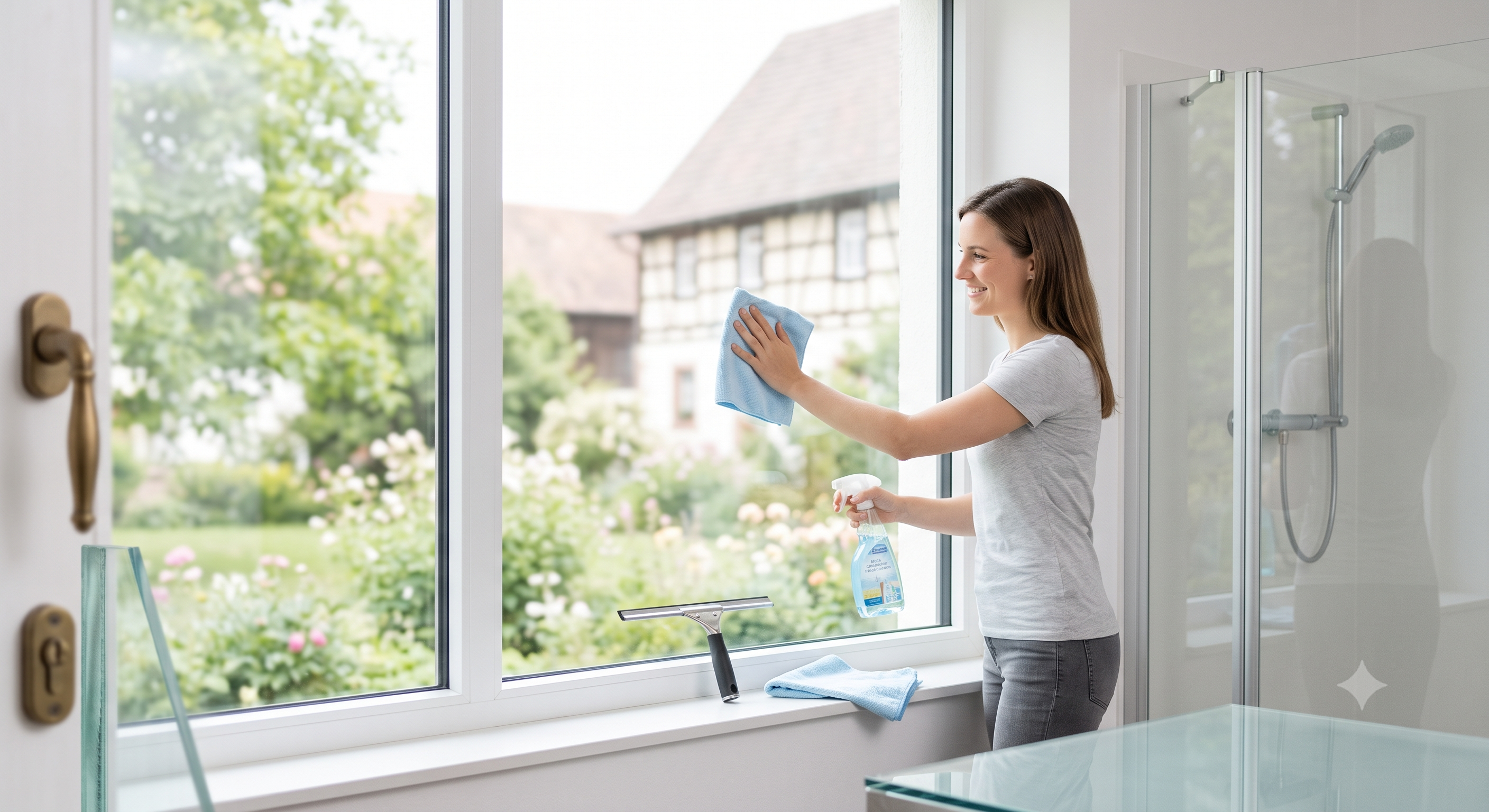
Cleaning glass sounds like the simplest household chore, until you find yourself staring at a pane full of streaks and no longer knowing whether the problem lies with the cleaner, the cloth, or the water. Yet, the correct approach differs significantly depending on the type of glass: a window, a shower screen, a satin-finish room divider, and a fireplace glass all require different agents and techniques. As a Bavarian glass specialist with roots dating back to 1857 and in-house ESG/VSG production since 2011, Adamer Sicherheitsglas knows not only how to maintain these materials, but also how they are manufactured. This guide shows how to clean glass streak-free, which home remedies actually work, and where cleaning alone reaches its limits.
Cleaning glass: The quick answer
Glass is best cleaned with lukewarm water, a mild cleaner, and a lint-free microfiber cloth, which should be moved in one direction with even pressure. Sufficient water is important to rinse away dirt particles instead of rubbing them across the surface, as is a second dry cloth for final polishing.
This basic rule applies to almost every type of glass in the home. The following sections explain how the details vary, which accessories are actually useful, and why some cloudiness cannot be removed with any cleaner in the world.
How to clean windows? The right equipment
The best way to clean windows depends less on the cleaning agent than on the tools used. A good glass cleaner, a clean rubber squeegee, and a lint-free microfiber cloth provide more reliable results than any "miracle" cure.
A basic set of equipment is sufficient:
- Glass cleaner: A commercially available, streak-free formulated professional glass cleaner removes films of grease and dust without leaving residue, making final polishing largely unnecessary.
- Microfiber cloth: A soft, lint-free microfiber cloth binds dust and moisture without scratching the surface, unlike newspaper, whose printer's ink can stain smooth surfaces.
- Squeegee: For larger surfaces or shower glass, a rubber squeegee prevents standing water and thus limescale stains before they even form.
- Glass scraper: For adhesive residues from stickers or paint splatters after renovation work, a glass scraper with a plastic slider is suitable, provided the blade is guided flat and without pressure.
The German Federal Association for Flat Glass (Bundesverband Flachglas) also generally advises using plenty of water when cleaning to avoid a scouring effect caused by trapped dirt particles—a detail that most household guides fail to mention, but which makes the difference between a clear result and new micro-scratches, especially with heavily soiled windows.
Cleaning windows without streaks: Step by step
You can clean windows streak-free by first removing dry dirt, then working over a large area with plenty of cleaning solution, and finally polishing in one direction with a dry cloth. Circular motions and spot-cleaning are the most common causes of streaks.
Streak-free window cleaning works reliably in this order:
- Dry dusting: First remove cobwebs, dust, and loose particles with a dry cloth or duster so that they do not act as sandpaper during wet wiping.
- Clean frames first: Clean the window frames and rebates before the pane so that no dirt drips onto the already cleaned glass later.
- Apply over a large area: Spray the cleaner evenly over the entire pane or apply it with a damp sponge, not just on specific spots.
- Wipe in one direction: Wipe horizontally or vertically, never in circles, so that streaks aren't highlighted in the light.
- Final polish: Use a second, dry microfiber cloth to polish the surface until no film of moisture is visible.
- Work in the right weather: Direct sun and frost cause the cleaner to dry too quickly or freeze; a cloudy day provides the best results.
The most common mistakes when cleaning windows
The most typical causes of streaks are using too little water, a cleaner that is too soapy, and cleaning in direct sunlight. Hard, limescale-rich tap water also leaves fine limescale rims when it dries, which look like streaks but are actually mineral deposits.
Limescale is not just a regional issue: according to an evaluation of 6,200 German water supply companies, the limescale content in parts of Thuringia and Bavaria is up to 46.5 °dH—more than three times the limit at which water is officially considered hard. If you live in a hard-water region, you will particularly benefit from polishing windows and shower glass with a dry cloth rather than letting them air-dry. t-online.de
Cleaning glass surfaces: Glass table, shower screen, and kitchen
Glass surfaces like glass tables or shower screens are best cleaned while damp and over a large area rather than in spots, because otherwise dust and grease can work their way into fine scratches during rubbing. After cleaning, a squeegee helps ensure no water dries on the surface and leaves behind limescale marks.
For glass tables, it is also recommended not to work in direct sunlight, as the cleaner will evaporate too quickly and leave streaks exactly where you wanted to avoid them. For shower screens made of safety glass, a shower squeegee with a wall mount is the most effective remedy against limescale stains, as it removes the water before it can dry—significantly more reliable than any subsequent cleaning agent. For those who want to clean less in the long term, the surface can additionally be treated with a glass sealant like the Invisible Shield Set, which forms an invisible protective layer that repels water and limescale.
Removing grease films from glass: What helps against stubborn coatings
Grease film on glass is usually caused by a mixture of grease, nicotine, or detergent residues and can be most reliably dissolved with rubbing alcohol (spirit) or isopropanol on a microfiber cloth. Afterward, the surface should be wiped down once more with clear water.
If a normal glass cleaner reaches its limits with stubborn dirt, this is often due to grease or silicone residues that do not dissolve in water. The Federal Association for Flat Glass recommends using common solvents like spirit or isopropanol for such cases, but simultaneously points to an important boundary that many guides overlook: Alkaline solutions, acids, and fluoride-based agents must generally not be used for glass cleaning, as they can permanently damage the glass surface. Classic drain cleaners or oven sprays therefore have no place near windows, mirrors, or shower screens.
Cleaning satin-finish glass and frosted glass correctly
Satin-finish glass should be cleaned exclusively with a soft microfiber cloth and a mild glass cleaner, never with scouring agents or steel wool, as these will permanently damage the fine matte structure. Frosted glass can tolerate the same gentle treatment but is overall easier to maintain due to its smoother surface.
The difference between the two types of glass lies in their manufacturing: Satin-finish glass is created by subsequent surface matting of clear glass, usually via acid etching, while frosted glass gets its opacity either through opacifying agents in the glass mass or as a fused layer. For cleaning, this means: satin-finish glass is more prone to fingerprints and harder to clean in its rougher, sandblasted version than the smoother, acid-etched variant. For those wanting to know more about manufacturing, characteristics, and appropriate maintenance depending on the process, detailed background information can be found in our guide What is satin-finish glass – The complete guide for your project.
What to do with "blind" windows? When cleaning no longer helps
A "blind" (cloudy) window cannot be made clear again by cleaning if the cloudiness is located in the space between the panes of insulating glass. In this case, the edge seal is leaking, moisture has penetrated between the panes and condensed there—a problem that no home remedy applied from the outside can reach.
This is the point where most online guides lose their way: they recommend cooking oil, newspaper, or vinegar water against "blind windows" without distinguishing between two completely different problems.
Blind pane or just dirty?
If the cloudiness can be influenced from the outside with a damp cloth, it is dirt or limescale and normal cleaning will help. If the cloudiness remains unchanged and is especially visible under certain light or weather conditions, the moisture is inside the gap between the panes; in this case, only professional renovation or replacing the glass helps.
Why home remedies don't help with genuinely blind panes
With multi-pane insulating glass, the space between the panes is hermetically sealed to keep moisture out. If the edge seal ages or is damaged, humidity penetrates, condenses inside, and can no longer be removed from the outside.
This exact mechanism is described by ift Rosenheim, which, as a neutral testing and certification body, has been researching the durability of insulating glass edge bonds for decades: Conventional insulating glass must be hermetically sealed to the outside so that as little moisture as possible enters the gap; if this seal is damaged, the effect cannot be reversed. Oil, vinegar, or alcohol only act on the outside of the pane and cannot reach the actual source of the problem.
A second, also frequently overlooked cause of permanently clouded glass is chemical etching: cement, mortar, or concrete slurry are highly alkaline and irreversibly attack the glass surface if not rinsed off immediately with plenty of water. The result looks confusingly similar to a blind pane, but it is permanent surface damage and not an issue of insulating glass construction.
Cloudy drinking glasses: a different problem
Anyone searching for "cloudy glasses" often doesn't mean a window, but murky drinking glasses from the dishwasher. This is usually glass corrosion caused by water that is too soft in combination with high dishwasher temperatures, which dissolves tiny calcium silicates from the glass surface. This cloudiness, unlike pure limescale film, also cannot be cleaned away because the glass surface itself is damaged. For heavily damaged, permanently cloudy drinking glasses, replacement is usually worthwhile. Our guide Disposing of drinking glasses – Household waste or recycling center? explains how to dispose of old glass correctly and environmentally friendly.
Cleaning mirrors without streaks
Mirrors are cleaned using the same basic rules as clear glass: mild cleaning agent, microfiber cloth, even strokes in one direction. However, with mirrors, there is an additional point that becomes expensive if applied incorrectly: moisture must not be allowed to reach the edges or the back of the mirror permanently.
The reflective coating on the back of the mirror is sensitive to moisture, especially at the edges. Anyone who sprays the mirror generously instead of applying the cleaner to the cloth risks moisture eventually running under the edges and attacking the silver coating from the inside, visible as dark spots on the edge that can no longer be removed. For mirrors in damp rooms, a shower squeegee used immediately after showering is the most effective measure against limescale and water spots, much more effective than subsequent polishing.
Anyone planning a new mirror and wanting to know what matters regarding custom fabrication, edge processing, and installation will find further information in our guide Custom mirrors – The complete buying guide 2026.
Fireplace glass and heat-resistant glass: different rules
Fireplace glass panes made of heat-resistant glass-ceramic should not be cleaned with normal glass cleaner, but with special fireplace glass cleaners or, for light soiling, with moistened ash on a paper towel. Commercially available glass cleaners often contain ammonia or alcohol, which burn onto the hot, sooty surface of fireplace glass in streaks instead of cleaning it.
The reason lies in the material: heat-resistant glass is not glass in the classic sense, but a glass-ceramic with completely different expansion behavior and surface structure than float glass. Soot deposits also stick more firmly than ordinary window dirt and only loosen with dedicated cleaners or mechanically with a fireplace glass scraper—never when the glass is hot. More on material properties, replacement, and what to look out for when buying can be found in our guide ROBAX Glass: Buying & replacing fireplace glass.
What you should definitely avoid when cleaning glass
Certain tools and agents cause more harm than good on glass surfaces, especially with finished or coated glass. These points apply regardless of whether you are dealing with windows, mirrors, or satin-finish surfaces:
- No pointed or sharp metal objects: Blades or knives, if used improperly, cause scratches that can no longer be removed.
- No "shaving" with a glass plane: This method, known in specialist companies for large-scale cleaning, is not permitted for cleaning entire glass surfaces according to the Federal Association for Flat Glass.
- No polishing machines on ESG: With tempered safety glass, polishing out surface damage leads to a loss of strength; the safety of the component is no longer guaranteed afterwards.
- No aggressive chemicals: Alkaline solutions, acids, and fluoride-based cleaners permanently attack the glass surface and have no place in glass cleaning.
- No dry wiping if heavily soiled: Dirt rubbed while dry acts like sandpaper and leaves fine scratches, often only visible in reflected light.
Comparison: Home remedies vs. professional glass cleaner
|
Cleaning method |
Effect against grease/film |
Streak-free |
Suitability for satin-finish glass |
Suitability for coated/ESG glass |
|
Water + Dish soap |
Medium |
Medium, prone to streaks if too much soap |
Conditionally suitable |
Suitable, with soft cloth |
|
Vinegar water |
Good for limescale, weak for grease |
Good if dosed correctly |
Suitable |
Suitable |
|
Spirit/Isopropanol |
Very good for grease/adhesive residue |
Very good |
Not recommended for matte finishes |
Suitable, use sparingly |
|
Profi-glass cleaner |
Very good |
Very good, no polishing needed |
Suitable with mild cleaner |
Suitable |
|
Scouring agents/steel wool |
Good, but damages surface |
Poor, leaves scratches |
Not suitable |
Not suitable |
|
Newspaper |
Weak |
Medium, risk of ink smearing |
Not recommended |
Conditionally suitable |
Cleaning windows safely: Ladders and working at heights
Windows on upper floors should only be cleaned using a stable, tested ladder, never from the windowsill. Overreaching or leaning out over the ladder is one of the most frequent causes of falls during cleaning.
This point is usually covered in a subordinate clause in classic cleaning guides, but it deserves more attention: in 2024, 16,617 people died in Germany due to domestic accidents, more than five times the number of road traffic deaths in the same year, and falls while cleaning windows are, according to the same evaluations, among the typical causes of accidents in the household. The Employer's Liability Insurance Association for the Construction Industry (BG Bau) fundamentally recommends for work at height to check whether work equipment with a lower risk than a portable ladder is available, such as stepladders with a platform or telescopic poles for high-level facade surfaces. For the private household, this means specifically: it is better to have a second person secure you, do not set up the ladder on wet or uneven ground, and if stability is questionable, rely on professional glass cleaning.
Cleaning glass is easy, until it isn't!
Cleaning glass is straightforward in most cases, as long as the tools, cleaning agents, and technique match the respective type of glass. Streak-free results are achieved through sufficient water, a uniform wiping direction, and the right cloth, not through aggressive chemicals. More important still is knowing where cleaning reaches its limits: a truly fogged pane, etched glass, or permanently damaged drinking glasses cannot be restored through any amount of thorough cleaning.
Adamer Sicherheitsglas provides advice from the appropriate care to custom-made new panes, mirrors, or shower glazing, with artisanal experience since 1857 and in-house safety glass production since 2011. Get in touch now or configure custom glass.
Frequently asked questions about cleaning glass
How do I get glass clear again?
That depends on the cause. If it is a film of limescale or grease on the surface, thorough wet cleaning with sufficient water and buffing will help. If, on the other hand, the cloudiness is in the space between the panes of insulating glass or if the glass surface itself is chemically damaged, it cannot be reversed by any cleaning.
Can you make dull glass shiny again?
Only if the dullness comes from a coating, such as dried-on cleaner, limescale, or grease, which can be removed with the right agent. If fine scratches or chemical etching are the cause, the glass surface is permanently altered and cannot be buffed back without further damaging the structure.
How do I remove gray haze from glasses?
A gray haze on drinking glasses after the dishwasher is usually a mixture of limescale and grease and can often be dissolved with a bath in diluted citric acid or vinegar essence. If the haze remains unchanged afterwards, it is glass corrosion, a permanent damage to the glass surface against which no cleaner can help.
What do professionals use for window cleaning?
Professionals work with a washer and rubber squeegee instead of a spray bottle and cloth: the pane is washed, pulled off in one go from top to bottom with the squeegee, and the blade is wiped dry after each stroke. A mild, concentrated solution, such as a professional glass cleaner, is sufficient; it is the technique, not the most expensive agent, that is decisive.
What should not be cleaned with glass cleaner?
Coated glass such as sun protection, anti-reflective, or self-cleaning surfaces as well as tempered safety glass (ESG) cannot tolerate aggressive or incorrectly dosed cleaners and should be treated according to the manufacturer's instructions. Natural stone, matte painted frames, and touchscreens should also not be treated with classic glass cleaner, as it can cause stains or damage there.


