

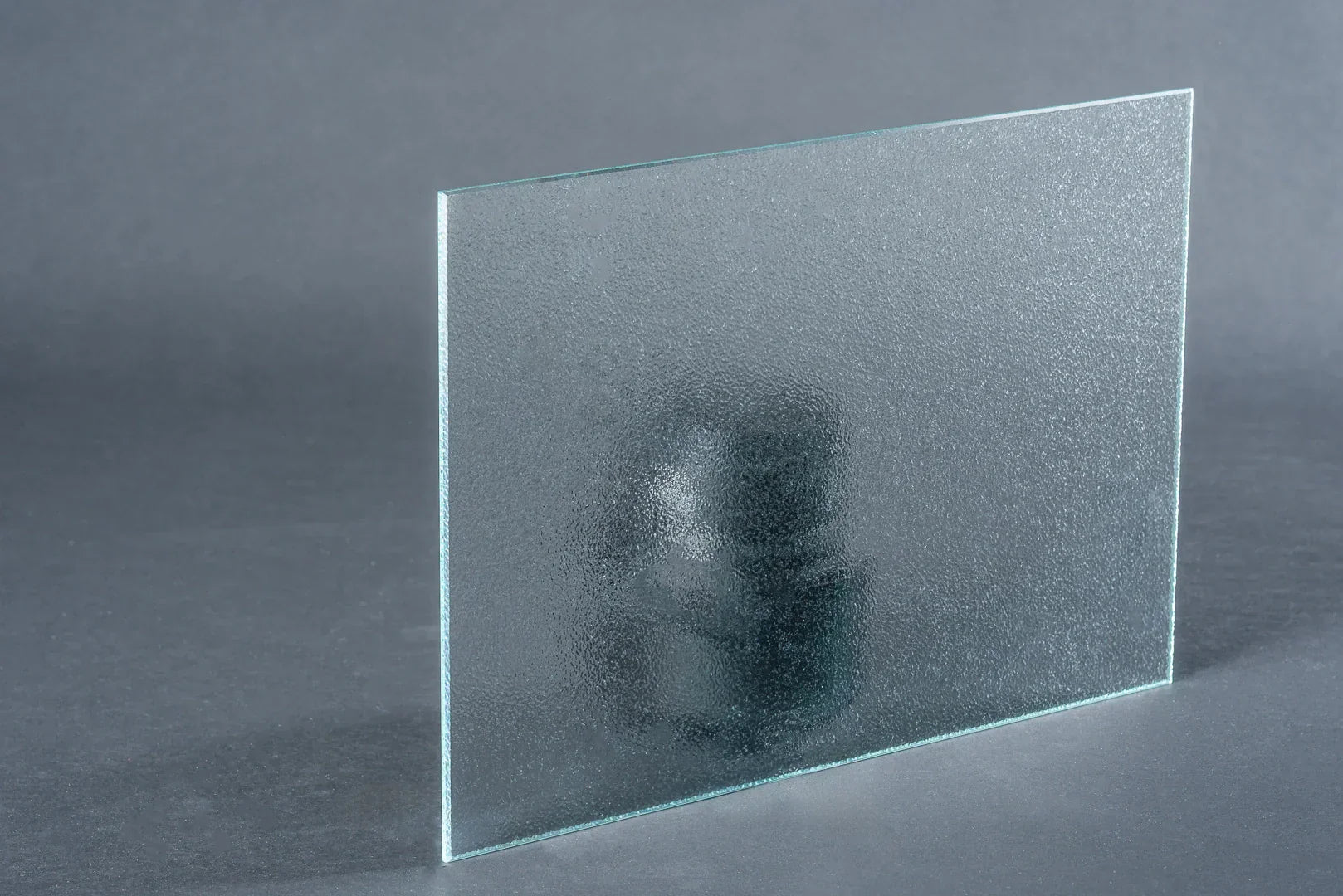
Patterned glass is the discreet solution for anyone wanting to let light into their home without sacrificing privacy. Whether used in a front door, a bathroom, or as a room divider, textured glass is one of the most versatile building materials for both indoor and outdoor applications. In this guide, we show you the different types of patterned glass available, how to find the right pattern for your project, and why patterned glass can even be combined with safety glass.
What is patterned glass?
Patterned glass, also known as cast glass or textured glass, is rolled flat glass with a textured surface. The patterns are created by passing the molten glass through embossed rollers, which makes the glass translucent—meaning it lets light in, but is not transparent. According to the European standard DIN EN 572-1, patterned glass is defined as flat, translucent, clear or colored soda-lime silicate glass that has a more or less pronounced patterned surface on one or both sides.
An overview of patterned glass types
Before deciding on a pattern, it is worth taking a look at the common types of patterned glass. They differ primarily in two respects: how much they obscure the view and how much light they let through. At Adamer, you will find a selection of the most common patterns in the textured glass category, where currently available textures and their dimensions are listed.
Chinchilla-style and Cathedral patterned glass: the most popular patterns
The pattern known as "Chinchilla" is a brand name for a fine, directional structure that resembles the fur of the rodent of the same name. At Adamer, you can get Ornament CH, a structure in the Chinchilla style—a visually comparable reproduction, not the trademarked original. It is one of the most popular structures for windows and doors because it offers a good balance between privacy and light transmission.
Cathedral patterned glass has its origins in classical cast glass for church windows and in Art Nouveau: at the time, cathedral glass was often used alongside patterned glass for decorative glazing in the architecture of the turn of the century. Adamer offers this pattern in two embossment sizes, large cathedral and small cathedral, so that you can adapt the structure to the surface area of your project. The hammered, irregular surface has a traditional look and is particularly suitable for heritage-protected buildings or renovations of old buildings.
Anyone searching online for "Satinato" patterned glass is generally referring to this matte, satin-finished glass. At Adamer, it is often colloquially referred to as satinized glass, but in our range, it is an independent product line: satinized glass and extra-white satinized glass. Technically, it differs from rolled patterns because the matte surface is created by acid etching or sandblasting based on float glass and is usually only satin-finished on one side, without showing a directional structure.
Patterned glass 504 and Old German: classics with character
The Ornament 504 structure shows an irregular, crumbly pattern with high light diffusion, a reason why it is often used in bathrooms and basement windows. "Old German" (Altdeutsch) patterned glass is visually based on historical window panes with a wavy, slightly irregular surface and therefore fits well with renovation projects where a traditional look is required; at Adamer, you can find this structure as Altdeutsch K.
In addition, Adamer carries further textured glass patterns for more specialized applications: Mastercarre with its striking check pattern, Baroque and Gothic for decorative, historically inspired projects, Ornament 178 as another fine structure, as well as wired glass and garden glass for applications where fracture resistance or light diffusion for plants is the priority.
Patterned glass overview: privacy and light transmission compared
Which patterned glass offers the best privacy? The denser and finer the structure, the higher the level of privacy. Satinized glass and heavily patterned variants such as Ornament CH (Chinchilla look) block almost every contour, while coarser patterns like cathedral glass still allow shadowy outlines to shine through.
For a quick orientation, we have compared the most common types of patterned glass:
|
Patterned glass type |
Privacy |
Light transmission |
Typical use |
|
Ornament CH (Chinchilla look) |
High |
Medium to high |
Front doors, windows |
|
Cathedral large / small |
Medium |
High |
Old buildings, church window look |
|
Satinized glass |
Very high |
Medium |
Bathroom, shower partition |
|
Ornament 504 |
Medium to high |
High |
Bathroom, basement windows |
|
Altdeutsch K |
Medium |
High |
Renovation, historic buildings |
|
Mastercarre |
High |
Medium |
Doors, modern interiors |
|
Garden glass |
Low to medium |
Very high |
Greenhouse, conservatory |
These values are general guidelines for each pattern category. The actual light transmission also depends on glass thickness, installation situation, and light incidence. Dimensions, dimensional tolerances, and quality requirements for patterned glass are specifically regulated in DIN EN 572-5, the dedicated part of the glass standards series for patterned glass.
Patterned glass catalog: how to choose the right design
Three questions you should ask yourself before ordering will help you choose:
- How much privacy do you really need? A bathroom window facing the street requires more privacy than an interior door in a hallway.
- How much light should pass through? Especially in windowless hallways or basement rooms, light diffusion is often more important than the privacy factor.
- What look suits the building? An old building is more suited to cathedral or Old German patterns, while modern new builds look more consistent with clear, directional structures like Ornament CH.
A selection of the most common patterned glass designs—currently eleven structures—can be found in the textured glass category. For a personal assessment of which pattern suits your installation situation, we are happy to discuss your requirements with you directly.
Patterned glass for doors and windows: the most common areas of application
Patterned glass is used wherever daylight is desired but visibility needs to be prevented. This explains why it has proven its worth for decades in three areas of residential construction.
Patterned glass for front doors: translucent privacy at the entrance
Patterned glass for front doors is one of the most common inquiries of all: at the front door, patterned glass serves two purposes: it lets daylight into the entrance area while simultaneously preventing a direct view into the house from the outside. Because front doors are subject to heavy use and usually have increased security requirements, the patterned glass is often reinforced; more on this in the next section.
Patterned glass for interior doors: privacy indoors
For interior doors, such as those leading to an office, bathroom, or bedroom, patterned glass ensures that light can flow through the entire apartment without the rooms being fully visible. This effect is particularly noticeable in dark hallways without windows.
The same principle applies to patterned glass in bathroom, stairwell, or basement windows: daylight instead of artificial light, without compromising privacy. Those who choose windows with patterned glass usually combine several patterns in the house, for example, a finer one in the bathroom and a coarser one in the stairwell.
Modern patterned glass combinations: with safety glass from a single source
Can patterned glass be tempered? Yes. According to DIN EN 572-1, patterned glass can be further processed and refined, including into single-pane safety glass (ESG). As a result, a tempered patterned glass pane combines a decorative look with the breakage properties of safety glass. At Adamer, we offer this tempering for patterned glass; however, we do not perform bonding into laminated safety glass (VSG) for patterned glass, as the textured surface does not allow for reliable bonding with the PVB interlayer film.
It is precisely this option that distinguishes a specialized company with its own manufacturing capabilities from a pure cutting shop. Patterned glass as base glass is suitable for tempering into ESG. For front doors or shower partitions, this means you do not have to choose between aesthetics and breakage safety.
Adamer has been processing patterned glass and float glass as a classic specialized glass company since 1857, and ESG and VSG production was added in 2011 as an in-house production line. Specifically for patterned glass, we offer tempering into ESG: pattern selection and tempering come from a single source, rather than having to be coordinated between several trades.
Important for planning: like float glass, patterned glass only serves as base glass for further processing. The thermal tempering process into ESG only takes place after cutting to size; subsequent tempering of already cut panes is not possible.
Additional expertise is worth it for two use cases: Safety-relevant glazing, such as in all-glass doors or fall-protection components, is tested and certified by independent institutes such as the ift Rosenheim before it can be used in construction. And where patterned glass is glued or installed in load-bearing all-glass constructions, a general construction type approval from the German Institute for Construction Technology (DIBt) is required, depending on the design—a point an experienced specialized company considers from the very beginning.
Cutting, maintaining, and ordering patterned glass
Untempered patterned glass can be processed with a glass cutter, just like regular float and mirror glass, though with more uniform contact pressure because the profiled surface deflects the cutting head more easily than a smooth pane. Once patterned glass has been tempered into ESG, subsequent cutting is no longer possible; any attempt will destroy the pane. For custom-made products, it is therefore recommended to finalize the exact dimensions before ordering.
Regarding maintenance: the smooth side of the pane should face outward or toward the room, while the textured side should face into the component. This makes cleaning considerably easier, as patterned glass—like many other flat glass applications—can be cleaned with standard glass cleaners, provided the structure is not treated with abrasive agents. By the way, patterned glass is not suitable for use in the immediate vicinity of a fireplace; heat-resistant glass with different thermal properties is needed here.
Glass waste generated during cutting does not have to end up in the general trash: for flat glass shards from processing companies, there is already a comprehensive collection and recycling network in Germany, through which clean float and patterned glass scraps are returned to the melting process.
Ordering custom patterned glass from Adamer
Patterned glass combines daylight and privacy like few other building materials and only truly becomes suitable for everyday use in front doors and other safety-relevant areas once tempered into ESG. The topic is particularly relevant right now: according to forecasts from VFF and the Federal Flat Glass Association, the German window market is set to grow by up to 3.1 percent in 2026 to around 13.3 million window units, with renovations now accounting for almost 70 percent of the market.
This is hardly surprising, considering that according to a current BF/VFF study, around 209 million window units in Germany are in need of energy-related renovation. Patterned glass is frequently in demand for such projects because privacy and daylight can be improved in one go. If you are planning custom patterned glass for your project, we will support you from pattern selection to professional tempering—all from a single source, and at home in Bavaria for over 165 years. Contact us for a non-binding consultation.
Frequently asked questions about patterned glass
Is patterned glass completely opaque?
No, patterned glass is translucent, meaning it transmits light but is not transparent. Depending on the pattern density, it still allows shadowy contours to be seen; for maximum privacy, fine, dense structures like satinized glass or Ornament CH (Chinchilla look) are best.
Can patterned glass be used as insulating glass?
Yes, patterned glass can be integrated into multi-pane insulating glass. The textured pane is usually installed as the outer layer with the embossed side facing inward, while a smooth pane provides thermal or sound insulation.
Is patterned glass suitable for outdoor use?
Generally yes, for example in front doors or canopy roofs. For overhead or heavily loaded outdoor applications, patterned glass is usually further processed into ESG to ensure the necessary fracture safety.
How does patterned glass differ from frosted glass?
Patterned glass receives its structure through the rolling process directly during glass production. Frosted glass looks, on the other hand, are often created subsequently by sandblasting, etching, or an applied film and are technically classified as satinized glasses.


