

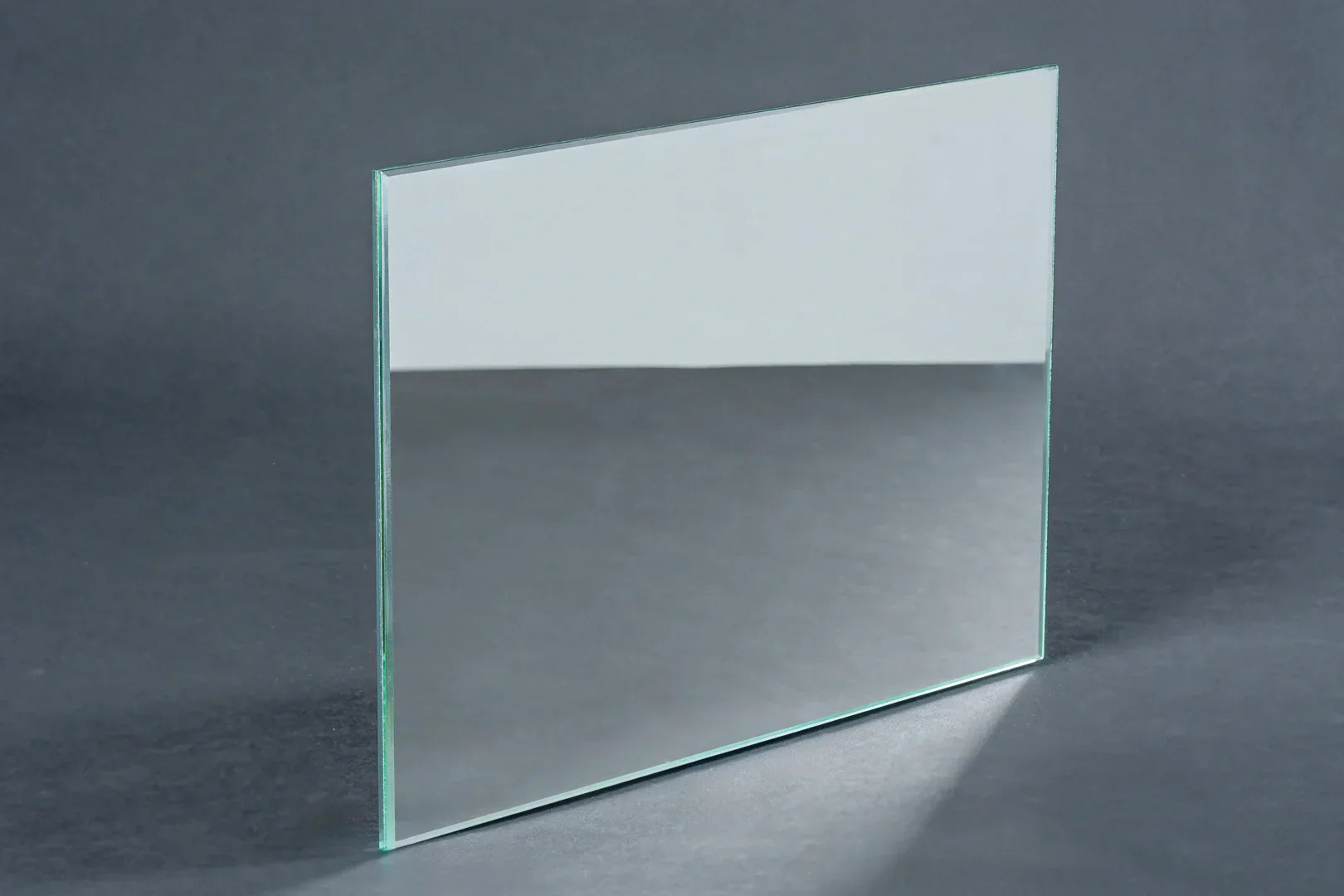
A mirror that fits to the millimeter sounds like a luxury problem, but it is the most sensible decision for bathroom renovations, dressing rooms, or shop fitting. After all, standard dimensions are rarely truly standard. Those who have a mirror made to measure receive not only the exact size needed but also a choice between glass types and mounting solutions, tailored to the specific location of use.
In this guide, you will learn everything that is truly crucial before ordering: which mirror types are available, what the difference between silver and laminated safety glass (VSG) mirrors means in practice, how to take measurements correctly, and when a specialist company is the better choice compared to an online shop.
What is a custom mirror and when is it worth it?
A custom mirror is an individually cut mirror pane that is manufactured exactly according to your specifications, including desired dimensions, glass thickness, and shape. It is always worthwhile when standard formats do not fit or when there are specific safety or design requirements.
Standard mirrors come in three or four formats and therefore rarely fit the narrow niche next to the shower, above an expansive double vanity, or into a sliding closet door. A custom mirror closes these gaps precisely.
The global mirror market underscores that custom-made products are in increasing demand: The global mirror market is estimated at USD 156.27 billion in 2026 and is expected to grow to around USD 296.87 billion by 2035, corresponding to an annual growth rate of 7.39 percent. The primary driver is the rising demand for individually designed interior spaces and renovation projects.
Which mirror types does Adamer offer?
Choosing the right mirror glass is not trivial. Different areas of application place different demands on reflection quality, color hue, suitability for damp rooms, and shatter resistance. Adamer offers five mirror types as custom cuts, each with a distinct character. All mirrors are offered online exclusively with a polished edge – a highly polished, ground edge that ensures a clean, safe, and elegant finish and is ideal for frameless mounting.
Mirror (Silver, float glass base)
The classic silver mirror is based on silver-coated float glass and provides a neutral, distortion-free reflection. Available in thicknesses of 3, 4, 5, 6, and 8 mm, with a polished edge for a clean, high-quality finish. Thanks to custom manufacturing, it can be precisely adapted to any installation situation, from bathroom mirrors and hallway mirrors to large-scale mirror walls. Manufactured in Germany by Christian Adamer GmbH.
Important to know: For damp rooms with constant exposure to water, such as directly next to shower fixtures, a carefully sealed edge is crucial for longevity.

Bronze mirror
The bronze mirror is based on silver-coated bronze glass and creates a warm, golden-brown hue in the reflection due to the characteristic bronze tint of the base glass. This effect provides an especially elegant, decorative appearance, ideal for sophisticated interior designs, design projects, bathrooms, and representative rooms where a stylish design element is required. Available in 4 and 6 mm thickness, with a polished edge.

Bronze mirror - Check price now
Grey mirror
The grey mirror is a silver-coated mirror on a grey glass base that combines functional mirror quality with a cool, contemporary aesthetic. The neutral grey tint of the base glass gives the reflection a subtly subdued, modern character, ideal for minimalist interior designs, stylish bathrooms, and architectural design concepts where a clear, restrained appearance is desired. Available in 4 and 6 mm thickness, with a polished edge.

Antique mirror
The antique mirror is a decorative mirror with an artificially aged mirror surface, whose irregular spots and patina effects give the glass a characteristic antique appearance. Each mirror is a unique piece; the individual patterning provides a unique, warm look with vintage charm. Ideal for stylish wall design, furniture fronts, sliding doors, room dividers, and exclusive interior architecture where a nostalgic, decorative accent is sought. Available in 4 mm thickness with a polished edge, made to measure.

Antique mirror - Check price now
VSG Mirror
The VSG mirror from Adamer is a laminated safety glass mirror: a mirror pane and a clear pane are invisibly laminated together using a PVB film. In the event of breakage, the film holds the shards together and significantly minimizes the risk of injury. Available in 6.76 mm total thickness, with a polished edge.
VSG mirrors are the first choice in safety-relevant areas: gyms, dance studios, children's rooms, public sanitary facilities, and stairwells. Those who would like to dive deeper into the differences between toughened safety glass (ESG) and VSG will find comprehensive decision-making help in our guide to custom safety glass.

Comparison table: The Adamer mirror range at a glance
|
Type |
Base |
Thicknesses |
Edge processing |
Typical application |
|
Mirror (Silver) |
Float glass, silver-coated |
3 / 4 / 5 / 6 / 8 mm |
Polished edge |
Bathroom, hallway, living area |
|
Bronze mirror |
Bronze glass, silver-coated |
4 / 6 mm |
Polished edge |
Bathroom, dressing room, representative rooms |
|
Grey mirror |
Grey glass, silver-coated |
4 / 6 mm |
Polished edge |
Minimalist interiors, modern bathroom |
|
Antique mirror |
Float glass, aged coating |
4 mm |
Polished edge |
Wall design, furniture fronts, room dividers |
|
VSG mirror |
Laminated glass, PVB film |
6.76 mm |
Polished edge |
Fitness, children, commercial |
All prices incl. VAT, plus shipping. The final price is calculated based on your dimensions and configuration, configured directly on adamer.de, or by requesting a quote.
How to correctly measure a custom mirror?
Measure the width and height of the installation location at at least two points and use the smallest dimension as the basis. For wall or niche mirrors, a 2–3 mm margin on each side is advisable so that the pane sits without tension.
Anyone measuring for the first time typically makes one of two mistakes: either ordering too tightly (the mirror doesn't fit through the door frame) or too generously (the mirror overlaps the tiles). A simple method:
- Measure the width at three points (top, middle, bottom) and take the minimum
- Measure the height on the left, in the middle, and on the right
- Note holes, cutouts, and niches in a sketch
- Plan for a polished edge as standard – it is suitable for frameless mounting in almost all installation situations
Especially with slanted ceilings, irregular walls, or built-in furniture, it is worth having a specialist company take the measurements on-site. An incorrect cut cannot be corrected.
Why a polished edge is the standard at Adamer
The edge determines the look, safety, and longevity. Adamer offers all mirrors in the online shop exclusively with a polished edge: a highly polished, ground edge that is ideal for frameless wall mirrors without visible fastenings. It is safe because sharp broken edges are dulled, clean in appearance, and ensures a uniform, high-quality look across the entire range.
Where is a custom mirror used?
Custom mirrors are used wherever standard formats do not fit: bathrooms, dressing rooms, stairwells, gyms, dance studios, shop fitting, and architectural installations. The glass type depends on the requirements for damp room suitability, color hue, and shatter resistance.
Living area
Bathroom mirrors above single or double vanities, wall mirrors in the hallway and bedroom, full-length mirrors for the dressing room, decorative accent walls with antique mirrors.
Commercial and professional
Gyms and dance studios (VSG mirror mandatory), hair salons with large mirror walls, restaurant and hotel areas where bronze or grey tones set the atmosphere, department stores, and boutiques.
Architecture and interior design
Space-enlarging mirror walls, shop fitting, mirror applications in furniture fronts and room dividers, design accents with antique or tinted mirrors.
The global market for mirror glass is estimated at around USD 8.5 billion in 2025, with a projected annual growth rate of 6.2 percent through 2033, driven primarily by interior renovation projects. Those who want to learn more about the various application possibilities of flat glass will find a comprehensive overview in our article on the areas of application for flat glass. datainsightsmarket.com
Custom mirrors made of float glass: What is behind it?
Every conventional mirror begins as float glass, the transparent base glass produced using the float process, which forms the basis for almost all flat glass products. Our practical guide to float glass explains in detail what float glass is and how it is produced. The manufacturing processes of modern flat glass are also described in detail there.
For mirror production, the back of the float glass is coated with a wafer-thin silver layer and sealed with protective lacquers. Tinted variants, bronze and grey, use a correspondingly colored base glass that gives the reflection its characteristic warmth or coolness. VSG mirrors also receive a PVB film lamination. The quality of the base glass significantly determines how distortion-free and durable the finished mirror is.
The global flat glass market is estimated at USD 334.5 billion in 2025 and is expected to grow to around USD 596.6 billion by 2033, with an annual growth rate of 7.5 percent. skyquestt.com
Installing mirrors: The most common fastening methods
Custom mirrors are mounted either with mirror adhesive (full-surface, frameless), mirror clips or rails (visible, removable), or holes with mounting screws. The mounting method influences the look, load capacity, and later removability.
Mirror adhesive / mirror silicone
Full-surface bonding with mirror-compatible adhesive—no standard acrylate, as it destroys the silver coating. Results in a frameless, elegant look. Permanent and barely correctable.
Mirror rails and clips
Made of stainless steel or aluminum, visible but organized. Suitable for heavy mirrors of 6mm and up, as the load is distributed evenly.
Holes
For VSG mirrors and heavy formats using point fixings or concealed screw heads. Holes must be specified before cutting; retrospective drilling is not possible.
Specialist company or online shop? When to choose which
The global flat glass market exceeded a value of USD 156.2 billion in 2025 and is expected to grow to USD 356.3 billion by 2035 at an annual growth rate of 8.6 percent, driven by increasing construction activity and the demand for energy-efficient glass solutions. This growth market has spawned numerous online providers. However, not every requirement can be mapped via a configurator alone. gminsights.com
The online shop makes sense if rectangular standard formats are sufficient and no installation is needed.
A specialist company is the better choice if: special shapes, cutouts, or holes are required; VSG constructions or safety-related requirements exist; installation by the company is desired; or large formats are to be processed.
What began as a small glazing shop in 1857 is now a modern specialist company with deep roots in the region; from material selection and processing to final inspection, all production steps follow strict German quality standards. Adamer manufactures mirrors as custom cuts in all five types of the range and provides advice on the right selection for every requirement.
Requesting custom mirrors from Adamer
As a Bavarian glass specialist since 1857, Adamer combines traditional craftsmanship with modern manufacturing depth. Whether a bathroom mirror in classic silver, a bronze mirror for a restaurant concept, an antique mirror as a design statement, or an VSG construction for the fitness area, advice and quote requests are possible directly via adamer.de.
Frequently asked questions about custom mirrors
Can I cut a custom mirror myself?
Mirror glass can generally be cut, but the silver coating on the back makes the process more prone to errors than with normal float glass. Our guide on cutting glass gives an honest assessment of what is feasible. VSG mirrors cannot be cut at home; that requires industrial cutting equipment.
How long does a custom mirror last?
A high-quality silver mirror with a sealed, polished edge and correctly applied mirror adhesive will last for several decades in dry rooms. In damp environments, the quality of the edge seal and the coating determines the lifespan.
Can mirrors be recycled?
Due to the metal coating, mirrors do not belong in the glass recycling container. Our article on disposing of drinking glasses explains what happens with old glass and what the correct disposal routes are.
Which mirror type fits a minimalist bathroom?
The grey mirror is the obvious choice: its cool grey tint keeps the reflection subtle and contemporary, harmonizing with clear tile schemes and matte fixtures without competing.
Which standards apply to VSG safety mirrors?
VSG mirrors for fall-prevention applications are subject to the requirements of DIN EN 14449 as well as the building regulations of the respective federal states. The Federal Association of Flat Glass (Bundesverband Flachglas) publishes current leaflets on installation regulations and testing requirements.


