

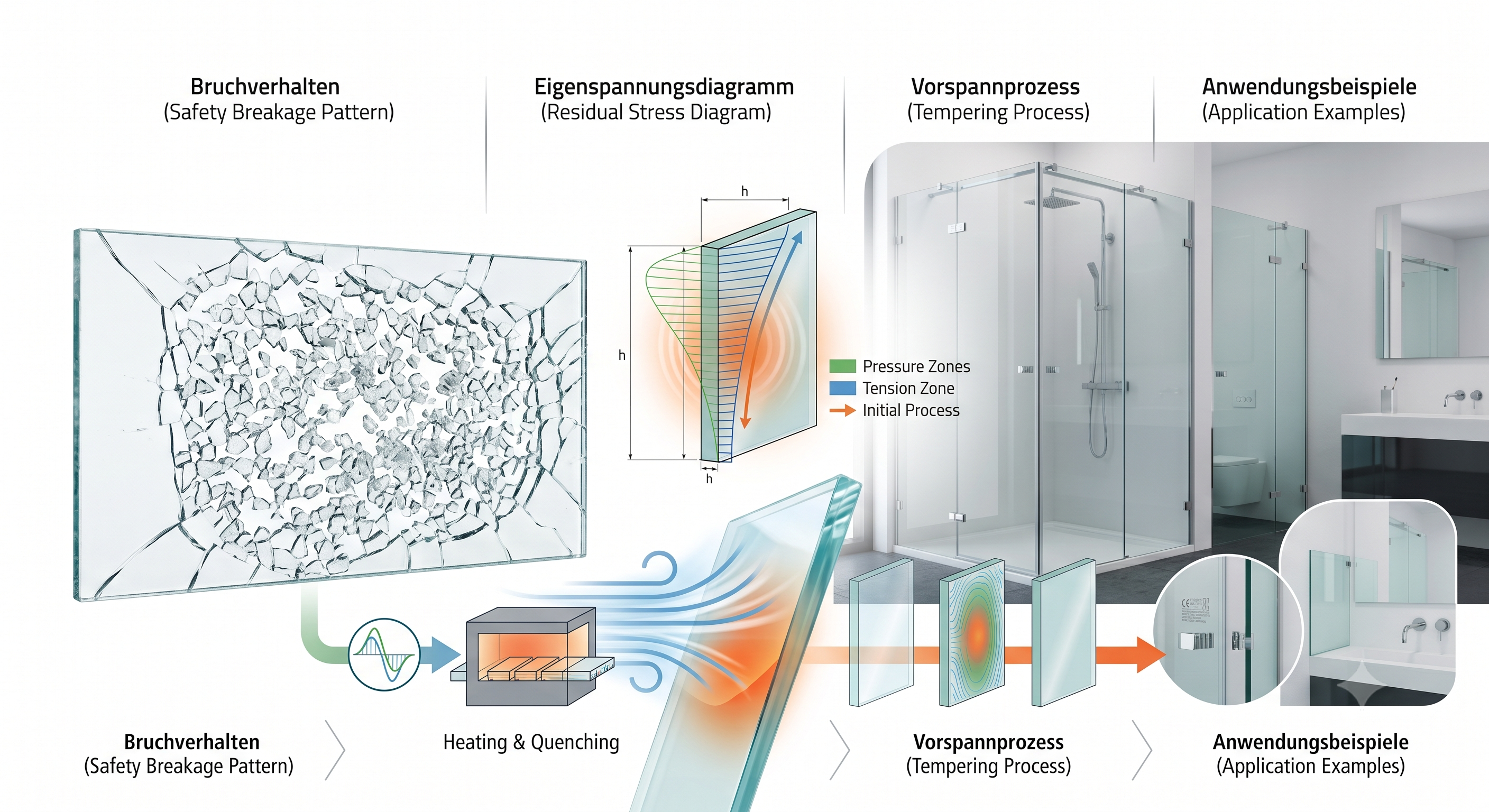
ESG glass (toughened safety glass) is float glass that has been subjected to stress by heating it to approximately 600 °C and then rapidly cooling it. If it breaks, it shatters into small, largely harmless granules rather than sharp-edged shards.
Those searching for "what is ESG glass" usually want to know two things: what distinguishes toughened glass from normal glass, and what is it used for? In 2024 alone, around 1.794 million tons of flat glass were produced in Germany, out of a total glass production of 6.661 million tons (German Environment Agency, as of 04.11.2025), and ESG glass makes up a significant share of this. We clarify both questions here in a compact form, including the detailed question that many guides omit: When does ESG require heat-soak testing, and what does this mean for planning?
ESG glass properties at a glance
The most important properties of ESG glass are high impact resistance, a safe fracture pattern, and significantly higher thermal shock resistance compared to float glass.
Toughened safety glass is standardized according to EN 12150 and must meet certain minimum values:
- Fracture behavior: shatters into small, blunt-edged granules instead of sharp splinters
- Bending strength: at least 120 N/mm² according to DIN EN 12150-1; commercially available ESG often achieves values over 200 N/mm² due to surface compressive stresses of 100–150 N/mm².
- Thermal shock resistance: up to 200 K, compared to around 40 K for float glass.
- Labeling: permanently marked with the manufacturer's mark and the standard designation "EN 12150"
This makes toughened glass significantly more robust than untreated float glass without losing transparency. To be technically precise: the tempering process increases bending strength, not surface hardness; "toughened glass" is the common colloquial term, while "thermally toughened" is the more precise technical term. A compact comparison of the bending strength values of float, heat-strengthened (TVG), and ESG glass is provided in the specialist article by Glas Lotsen.
How is an ESG glass pane manufactured?
During manufacturing, the ESG glass pane is heated to approximately 600 °C and then rapidly cooled with cold air. This creates compressive stress in the surface and tensile stress in the core.
Normal float glass serves as the base material, but satin glass or patterned glass can also be toughened into ESG safety glass. Important for planning: cutting, drilling, and edge processing must be carried out before the toughening process.
Can you cut or trim ESG glass?
No. Cutting ESG glass after the toughening process is not possible; any attempt to cut the pane will cause it to break immediately.
This is one of the most frequently underestimated points in planning. Anyone wishing to shorten a pane later or add a hole must order a new ESG pane with the correct dimensions. Our guide Cutting glass – what works and what doesn't explains all the details on the subject of cutting.
ESG or Laminated Safety Glass (VSG)
ESG is a single toughened pane with a safe fracture pattern but without residual load-bearing capacity after breakage. Laminated safety glass (VSG), on the other hand, consists of multiple panes with tear-resistant PVB film that holds together even after breakage, for example in railings or overhead glazing. According to DIN 18008-2, regular ESG may only be installed as a monolithic pane up to a height of 4 m above a traffic area, as even heat-soak testing does not guarantee a sufficiently low probability of failure; above this height, heat-soaked ESG-H or VSG is mandatory.
Practical application recommendations for safety glass are also provided by the VFF bulletin. We cover the complete comparison including selection criteria in detail in a separate guide on Customized safety glass: ESG or VSG as well as soon in a dedicated article "What is VSG glass?".
Areas of application: ESG glass for showers & more
Customized safety glass with ESG toughening is the first choice wherever cuts and injuries are to be avoided:
- Safety glass for showers: shower walls and shower enclosures
- All-glass doors and partition walls in interior design
- Furniture glazing, kitchen backsplashes, tabletops
- Large glass areas such as panorama windows where a stable single pane is required
- As a base for float glass further processing into VSG or insulating glass
ESG glass thickness, weight & price per m²
ESG glass is typically available from 4 mm to 19 mm thickness; for shower walls, 8 mm ESG glass is standard. The weight is calculated at 2.5 kg per mm of thickness per square meter.
An 8 mm thick ESG pane therefore weighs around 20 kg/m². The price per m² depends heavily on thickness, format, and processing (e.g., edge grinding, drilling), so general online price quotes are not very meaningful; an individual inquiry is worthwhile. You can find the exact weight formula, table values, and practical examples in our calculator guide Calculating glass weight.
Buying ESG glass: What to look for?
Before buying safety glass, it is worth looking at three points: the appropriate thickness for the application, the question of ESG or VSG, and whether heat-soak testing is necessary. The market is noticeably picking up: the renovation market for windows in Germany is forecast to grow by 3.5% in 2025 according to the Federal Association of Flat Glass and VFF, while new construction is declining by 5.5% – one more reason to plan a project early with an experienced specialist company. An overview of the German glass industry as a whole is provided by the Federal Association of the Glass Industry.
At Adamer, we have been producing ESG in our own facility since 2011; safety glass production takes place at our Kösching location, and the company is present at a total of four Bavarian locations. Prior to that, Adamer had been operating as a traditional glazier since 1857. We are happy to advise you on your individual project and manufacture it to the millimeter.
What is ESG glass: summarized!
ESG glass is thermally toughened safety glass according to EN 12150: robust, with a safe fracture pattern, but without residual load-bearing capacity and cannot be cut after the fact. It is suitable for showers, doors, and furniture glazing; for larger heights or overhead situations, it is worth considering ESG-H or VSG. Are you planning a project with custom ESG glass? Contact Adamer for a non-binding consultation.
Frequently asked questions about what is ESG glass
What are the disadvantages of ESG glass?
ESG has no residual load-bearing capacity; if the pane breaks, it fails completely. Furthermore, it cannot be cut or drilled after hardening, and from certain installation heights, additional heat-soak testing (ESG-H) is required.
Is ESG glass break-proof?
No, ESG can break. However, it is significantly more robust than float glass and shatters into small, largely harmless granules upon breakage instead of sharp splinters.
Is ESG real glass?
Yes. ESG is real, thermally toughened float glass – not plastic and not film glazing. The hardening process only changes the stress distribution in the glass, not the material itself.
Can ESG glass crack?
In very rare cases, yes, microscopic nickel sulfide inclusions can lead to spontaneous breakage years after installation. A heat-soak test (ESG-H) significantly reduces this risk.
When do you need ESG glass?
Always where there is a risk of injury from glass breakage, but where no residual load-bearing capacity is required – such as shower walls, all-glass doors, or furniture glazing.


