

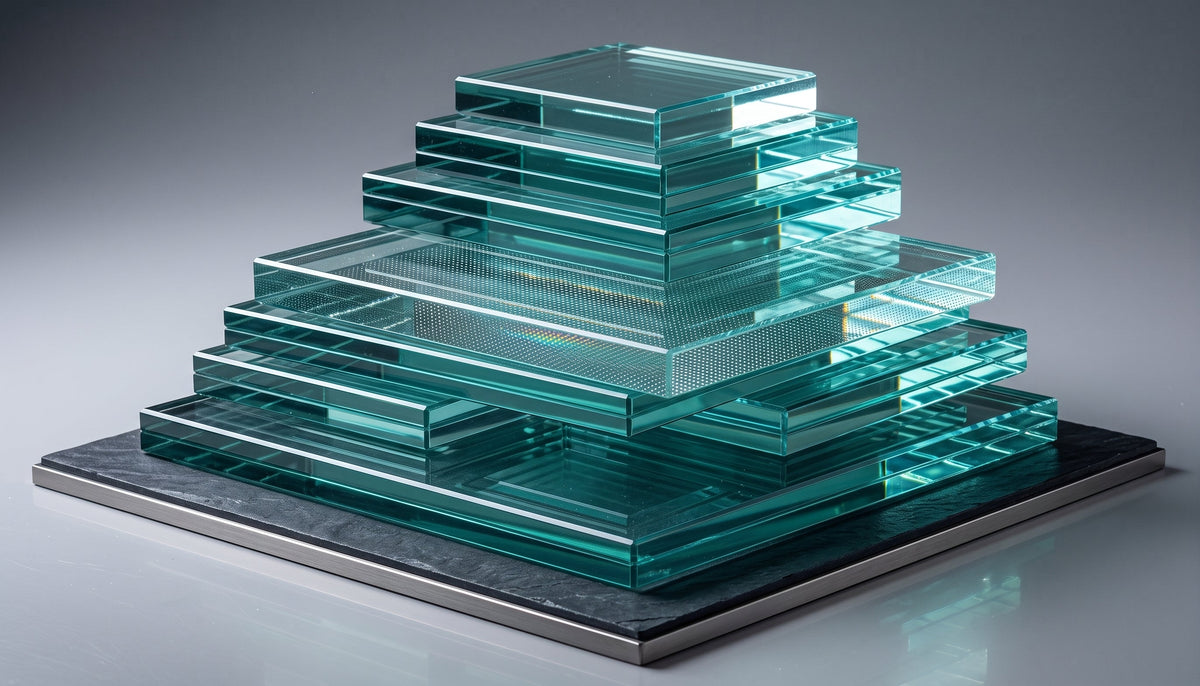
Safety glass is the collective term for types of glass that, compared to standard float glass, demonstrate significantly safer breakage behavior and must pass standardized tests to qualify. The two most important types are ESG (tempered safety glass) and VSG (laminated safety glass).
Anyone searching for "what is safety glass" usually ends up with articles that compare ESG and VSG and leave it at that. What is missing in most guides is the answer to the actually crucial question: when is glass even considered safety glass, and which standard determines this? We are here to provide this normative framework, concisely and without legal jargon.
The most important points at a glance
- Safety glass is a collective term, not a single product; ESG, VSG, and HSG are the most common variants.
- Whether glass counts as safety glass is determined by the pendulum impact test according to DIN EN 12600, not by intuition.
- ESG breaks into blunt granules but has no residual load-bearing capacity. VSG holds splinters in place with a film and remains in the frame even after breaking.
- For overhead glazing, fall protection, and walk-on surfaces, DIN 18008 prescribes specific safety glass requirements.
- Adamer has been manufacturing ESG and VSG in its own facilities in Kösching since 2011, at four Bavarian locations, building on over 165 years of glazier tradition since 1857.
What is safety glass?
Safety glass is flat glass that has been modified through thermal tempering or a tear-resistant film so that, when broken, it either shatters safely or holds together. This behavior is tested using the pendulum impact test in accordance with DIN EN 12600.
In everyday life, "safety glass" is often used synonymously with "shatterproof glass," but technically the term is defined more narrowly. Not every robust glass is automatically safety glass in the normative sense; it is only correctly referred to as safety glass once a glass type has undergone the classification process according to DIN EN 12600 and is assigned to a category (A, B, or C) based on its breakage behavior. This test simulates how a pane behaves upon human impact and has been the reference for safety glazing in the German construction industry since 2001.
Buying safety glass therefore does not automatically mean ordering a specific product, but rather choosing a type of glass that has been tested in accordance with the standards for its intended use.
What types of safety glass are there?
The three most common types of safety glass are ESG (tempered safety glass), VSG (laminated safety glass), and HSG (heat-strengthened glass), which usually serves as the basis for VSG. Additionally, wired glass is also considered a classic, albeit rarely installed, type of safety glass today.
Tempered safety glass (ESG) explained briefly
ESG is produced by heating glass to around 600 °C followed by rapid cooling. This creates compressive stresses that make the glass impact-resistant; if it breaks, it disintegrates into small, largely harmless granules instead of sharp-edged shards. ESG does not possess residual load-bearing capacity after breakage. We explain the complete manufacturing process, all properties according to EN 12150, and typical areas of application in detail in our guide What is ESG glass?
Laminated safety glass (VSG) explained briefly
VSG consists of at least two glass panes that are firmly bonded together by a tear-resistant PVB film. If one pane breaks, the splinters remain stuck to the film instead of falling, which ensures a certain level of residual load-bearing capacity. Our guide What is VSG glass? describes the structure, autoclave manufacturing, and all areas of application—from canopies to burglar-resistant patio doors—in detail.
HSG and other safety glasses
Heat-strengthened glass (HSG) undergoes a similar process to ESG, but with slower cooling. As a result, it breaks into larger, stationary splinters and is often used as base glass for VSG assemblies, for example in fall protection. Wired glass, which has a wire mesh embedded in it, is also considered an older type of safety glass and is still found in fire-protection and existing buildings today.
ESG or VSG: What is the difference?
ESG is a single, thermally toughened pane without residual load-bearing capacity, ideal for shower enclosures or glass doors. VSG consists of multiple bonded panes, holds together even after breakage, and is therefore the right choice for overhead glazing and fall protection.
|
Feature |
ESG (Tempered Safety Glass) |
VSG (Laminated Safety Glass) |
|
|
Structure |
A thermally toughened pane |
At least two panes with PVB film |
|
|
Breakage behavior |
Disintegrates into small, blunt granules |
Splinters remain stuck to the film |
|
|
Residual load-bearing capacity |
None |
Present, depending on construction |
|
|
Normative basis |
DIN EN 12150 |
DIN EN 14449 / DIN EN ISO 12543 |
|
|
Typical application |
Showers, glass doors, furniture glazing |
Overhead glazing, balcony railings, burglary protection |
|
|
Custom cutting |
Not possible |
Only possible with VSG made of float glass |
A detailed comparison, including a decision-making guide for your project, can be found in our guide Custom safety glass: ESG or VSG.
Which standards regulate safety glass in Germany?
The authoritative standards are DIN EN 12600 for pendulum impact test classification, as well as the DIN 18008 series of standards, which prescribes specific safety glass requirements for load-bearing, fall-protecting, and walk-on glazing.
For planners and building owners, DIN 18008 is particularly relevant: Part 2 regulates linearly supported glazing, Part 4 determines when VSG is mandatory for fall protection, and Part 5 concerns walk-on glass surfaces such as steps or bridges. For public buildings like schools or kindergartens, glazing must additionally be shatterproof in accordance with accident prevention regulations—a point that private owners often overlook during renovations. Which standard applies in an individual case depends on the installation height, usage, and fall risk, and should ideally be clarified with a specialist company before ordering.
Where is safety glass used?
Safety glass with ESG tempering or as an VSG assembly is used wherever there is a risk of injury or danger of falling:
- Windows with safety glass in ground-floor apartments and floor-to-ceiling glazing
- Front doors and patio doors with burglary-resistant properties
- Shower enclosures, all-glass doors, and furniture glazing in interior design
- Balcony railings, patio canopies, and other overhead glazing
- Stairs, walkways, and other walk-on glass surfaces
According to the Federal Association of Flat Glass, resistant glazing is an effective building block against burglary, an effect also supported by the current police crime statistics: in 2025, 82,920 residential burglaries (including attempts) were registered nationwide, but almost every second attempt (44.9%) failed due to security technology (polizei-beratung.de). Safety glass on windows and patio doors is one of several elements alongside hardware and locking technology.
Ordering custom safety glass: What to look for?
With custom safety glass, three points matter: the correct type of glass for the intended purpose (ESG or VSG), the appropriate thickness including weight calculation, and a specialist company with its own production instead of a pure cutting service.
Because ESG cannot be cut after tempering, cutting, drilling, and edge processing must be finalized before ordering. With VSG, the film thickness (0.38 mm or 0.76 mm are common) also determines the final dimensions. For weight calculation, the rule of thumb is 2.5 kg per millimeter of glass thickness per square meter; for VSG, the weight of the film is added. The complete formula with table values and practical examples is provided in our calculator guide Calculating glass weight.
Standardized types of glass like float glass or tempered safety glass can be configured to size directly in the shop. At Adamer, we have been producing ESG and VSG in our own facilities at our Kösching location since 2011. The company is represented at a total of four Bavarian locations and looks back on over 165 years of glazier tradition since 1857. In 2024 alone, around 1.794 million tons of flat glass were produced in Germany (Federal Environment Agency, as of 04.11.2025), a market in which specialist companies with their own production depth like Adamer are increasingly in demand, as confirmed by the Federal Association of the Glass Industry in its sector figures.
What is safety glass: in brief!
Safety glass is not a single product category, but the collective term for types of glass that pass the pendulum impact test according to DIN EN 12600 and must additionally comply with DIN 18008 depending on the application. ESG and VSG are the most practically relevant types, with HSG supplementing them as base glass. The intended purpose determines which variant is the right one: ESG for showers and furniture, VSG for overhead glazing and fall protection. Are you planning a project with custom safety glass? Contact Adamer for a non-binding consultation.
Frequently asked questions about safety glass
Is safety glass the same as tempered glass?
Not quite. Tempered glass (ESG) is a type of safety glass, but not the only one. VSG, for example, is not tempered but bonded by a film and is also considered safety glass.
What types of safety glass are there?
The most common are ESG (tempered safety glass), VSG (laminated safety glass), and HSG (heat-strengthened glass), which often serves as the base glass for VSG. Wired glass is considered an older safety glass variant.
Is safety glass legally required?
In certain situations, yes—for example, for fall protection, walk-on glass surfaces, or in public buildings such as schools. The DIN 18008 series of standards as well as state building regulations are then authoritative.
How do I recognize safety glass?
Compliant safety glass bears a permanent marking with the manufacturer's symbol and standard designation, such as "EN 12150" for ESG. Without this mark, it is almost impossible to visually determine the type of glass with certainty.
What is the difference between safety glass and normal glass?
Normal float glass breaks into sharp-edged, large shards. Safety glass is specially treated or constructed so that it either disintegrates into harmless granules (ESG) or holds together even after breaking (VSG).


