

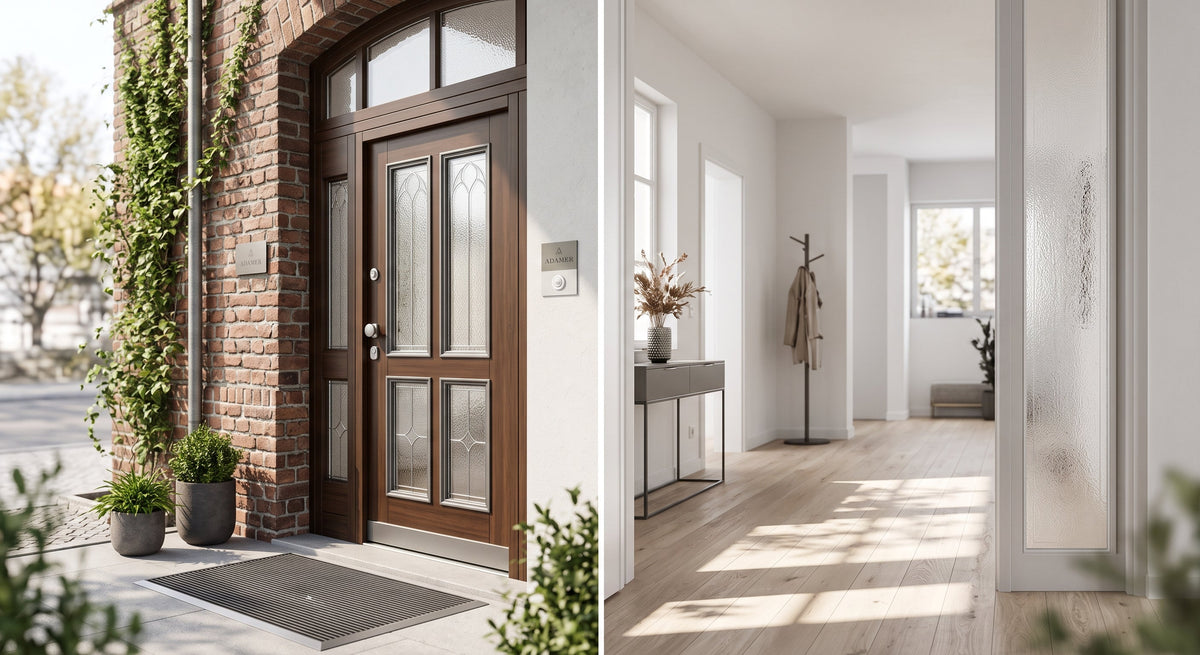
Some patterns look as if they came straight from an old stained-glass workshop. Gothic glass is just such a pattern. It brings a historical character to front doors, interior doors, and windows without you having to renovate a heritage-protected building. At the same time, the question quickly arises: does such an old-fashioned pattern even meet modern safety requirements? The answer is simpler than you might think.
In this guide, we will show you what defines Gothic glass, how it differs from other ornamental glass patterns, and where it can be sensibly used. We will also clarify whether the pattern can be tempered or laminated and just how heavy a finished pane actually is.
What is Gothic glass?
Gothic glass, also known as Ornament Gothic, is an ornamental glass with a historically evocative, rolled surface pattern. It allows daylight to pass through but prevents a clear view, and at Adamer, it is classified as part of the textured glass category.
Technically, Gothic glass belongs to the group of ornamental glasses (formerly also called cast glasses). According to the European standard DIN EN 572-1, ornamental glass is defined as flat, translucent soda-lime silicate glass with a patterned surface on one or both sides; Gothic glass is one of several possible expressions of this standard definition. Production takes place via a rolling process: the liquid glass mass is passed through textured rollers, the embossing of which is directly imprinted into the glass. It is precisely this process that gives the pattern its calm, historical effect—no printing, no subsequent processing, but a structure anchored in the material itself.
Ornamental glass is only a small but visible part of a large market: according to the Federal Association of the Glass Industry, flat glass accounts for about 26.9% of total German glass production, as shown by figures from the Federal Environment Agency. Those interested in the industry as a whole will find a good overview at the Federal Flat Glass Association (Bundesverband Flachglas).
Where does the Gothic pattern in ornamental glass come from?
The name "Ornament Gothic" does not refer to Gothic cathedrals in the strict sense, but to the design language of historical window glazing, as was common in old buildings and timber-framed houses. Similar to the Altdeutsch ornamental glass, the pattern is oriented towards a time when window panes did not yet have the flawless flatness of today's float glass. Precisely this slightly irregular, lively look is what makes Gothic ornaments interesting even today for renovation projects and historicizing new buildings.
This preference for historicizing patterns is not a niche phenomenon: international design media such as Adorno Design are currently observing a trend toward a contemporary Gothic style in interior design that consciously reinterprets historical design language instead of simply copying it.
Gothic clear glass vs. other ornamental glass patterns in comparison
Trade press such as Glaswelt also observes that the German flat glass market continues to develop steadily despite the growing importance of high-performance glass, and textured glass patterns like Gothic still hold their firm place within it. At Adamer, you will find a selection of the most common textured glass patterns, including not only Gothic but also Altdeutsch K, Baroque, Mastercarre, Ornament 178, Ornament 504, Ornament CH, as well as wired glass and garden glass for special applications. To help you categorize where Gothic clear glass fits visually, we have compared the most common patterns. The values are general guidelines for each pattern category and do not replace an on-site sample inspection.
|
Pattern |
Visual character |
Privacy |
Light transmission |
|
Gothic (Ornament Gothic) |
Historical, fine Gothic lines |
Medium |
High |
|
Altdeutsch K |
Wavy, irregular, historical |
Medium |
High |
|
Baroque |
Ornate, decorative |
Medium |
Medium-high |
|
Mastercarre |
Clear square pattern |
Medium |
High |
|
Ornament CH (Chinchilla look) |
Fine, directional structure |
High |
Medium |
The finer and denser a pattern is, the stronger the privacy protection and the lower the light transmission. Gothic glass sits in the middle range here: enough structure for subtle privacy, enough translucency to illuminate rooms in a friendly way.
In what thicknesses and finishes is Gothic glass available at Adamer?
Ornamental glass like Gothic is usually manufactured in 4 mm thickness and supplied with either a cut edge or a polished edge depending on the area of application, as is the case with comparable Adamer textured glass patterns like Ornament 504. Since details can vary slightly depending on the pattern, we recommend clarifying exact dimensions and edge options directly in the textured glass category or during a personal consultation before you order.
Can Gothic glass be tempered or laminated?
Gothic glass can be tempered into toughened safety glass (ESG) to achieve impact resistance and a safe breakage pattern. Adamer, however, does not offer processing into laminated safety glass (VSG) for ornamental glass, as the structured surface does not allow for reliable bonding with the PVB interlayer.
The safety gain through tempering is by no means a minor matter: according to ift Rosenheim, ESG disintegrates into small, blunt crumbs when broken instead of long, sharp-edged splinters like simple float glass, which significantly reduces the risk of injury. Independent advisory services such as Energie-Fachberater also classify ESG as a sensible basic protection level if a complete failure of the pane in the event of breakage is tolerable. Those who would like to know more about the fundamental difference between toughened and laminated safety glass can find a detailed classification in our foundational article What is safety glass?
This limitation affects not only Gothic, but all ornamental glass patterns in the Adamer range. Therefore, anyone who needs to satisfy both the historical look and a VSG requirement—for example, in fall-protection applications—should switch to a smooth type of glass such as satinized glass or clear float glass and incorporate the ornamental glass character through other design elements. For all applications where ESG is sufficient, such as door panels or interior glazing with increased impact resistance, Gothic glass remains a good choice.
Where can Ornament Gothic be sensibly used?
Ornament Gothic is particularly suitable for front doors, interior doors, windows in renovation projects, and room dividers where daylight is desired but a direct view is not.
Three areas of application stand out in particular:
Front doors
A glass cutout with a Gothic pattern brings daylight into the entrance area while simultaneously protecting against prying eyes from the outside; fittingly, glass cutouts are currently among the most influential front door design trends according to the Association of Windows + Facades (Verband Fenster + Fassade). Those wishing to consider additional burglary protection for the glass element in the front door can find good orientation regarding resistance classes in the recommendations of the prevention network Zuhause sicher.
Interior doors
Especially in old apartments, the historical pattern provides a harmonious transition between hallways and living spaces.
Renovation and historicizing new construction
Where a traditional look is required, Gothic ornaments blend naturally into wooden window frames or classically structured facades. This topic affects more buildings than one might think: in Germany, according to the Federal Flat Glass Association (Bundesverband Flachglas), around 209 million window units are in need of energy-related renovation; when replaced, the original character can be preserved with a pattern like Gothic glass instead of losing it.
Also as an element in room dividers or furniture fronts, Gothic glass sets subtle accents without making the room look dark or closed off.
How much does a pane of Gothic glass weigh?
The rule of thumb is: 2.5 kg per millimeter of glass thickness per square meter. A pane of Gothic glass with 4 mm thickness therefore weighs around 10 kg per square meter.
The formula is: Weight (kg/m²) = glass thickness (mm) × 2.5. For 4 mm Gothic glass, this equals 4 × 2.5 = 10 kg/m². Further calculation examples and a complete table for other glass thicknesses can be found in our article Calculating Glass Weight. Important: as soon as you have the pattern tempered into ESG, the basic weight remains the same, as only the stress structure in the glass changes during thermal toughening, not the amount of material. Only if processed into laminated glass would the weight of the film layer be added, usually in 0.38 mm or 0.76 mm thickness. Since Adamer generally does not process ornamental glass into VSG, this calculation step remains theoretical for Gothic glass.
Cleaning and caring for Gothic glass
Structured surfaces like those of Gothic glass collect dust and fingerprints a bit more easily in the recesses than smooth float glass. With a soft cloth, warm water, and a streak-free glass cleaner, however, the pattern can be maintained just as easily as other types of glass. A detailed step-by-step guide, including tips for household remedies, can be found in our guide Cleaning glass without streaks.
Gothic glass as a historical accent with modern safety
Gothic glass combines a calm, historical character with the practical advantages of ornamental glass: yes to daylight, no to a clear view. For front doors, interior doors, and renovation projects, it is one of the most harmonious options in the Adamer range of textured glass, especially if you want to combine the look with ESG tempering. Are you planning a project with Gothic glass? Adamer would be happy to advise you on dimensions, edge finishes, and tempering options.
Frequently asked questions about Gothic glass
Is Gothic glass the same as ornamental glass?
Yes, Gothic glass is a specific pattern within the larger category of ornamental glasses. All ornamental glasses are created using the same rolling process, but differ in their pattern, degree of privacy, and light transmission.
What distinguishes Gothic ornaments from Baroque patterns?
Gothic ornaments appear calmer due to finer, linear structures, while Baroque patterns appear more ornate and decorative. Both are among the historically evocative textured glass patterns at Adamer.
Can Gothic glass be cut like normal float glass?
Ornamental glass like Gothic can be cut, but requires even pressure, as the profiled surface can easily deflect the cutting head. Details on this can be found in our article Cutting glass.
Is Gothic glass available as safety glass?
Yes, as ESG. Adamer does not offer processing into VSG for ornamental glass, as the structured surface does not allow for reliable bonding.


