

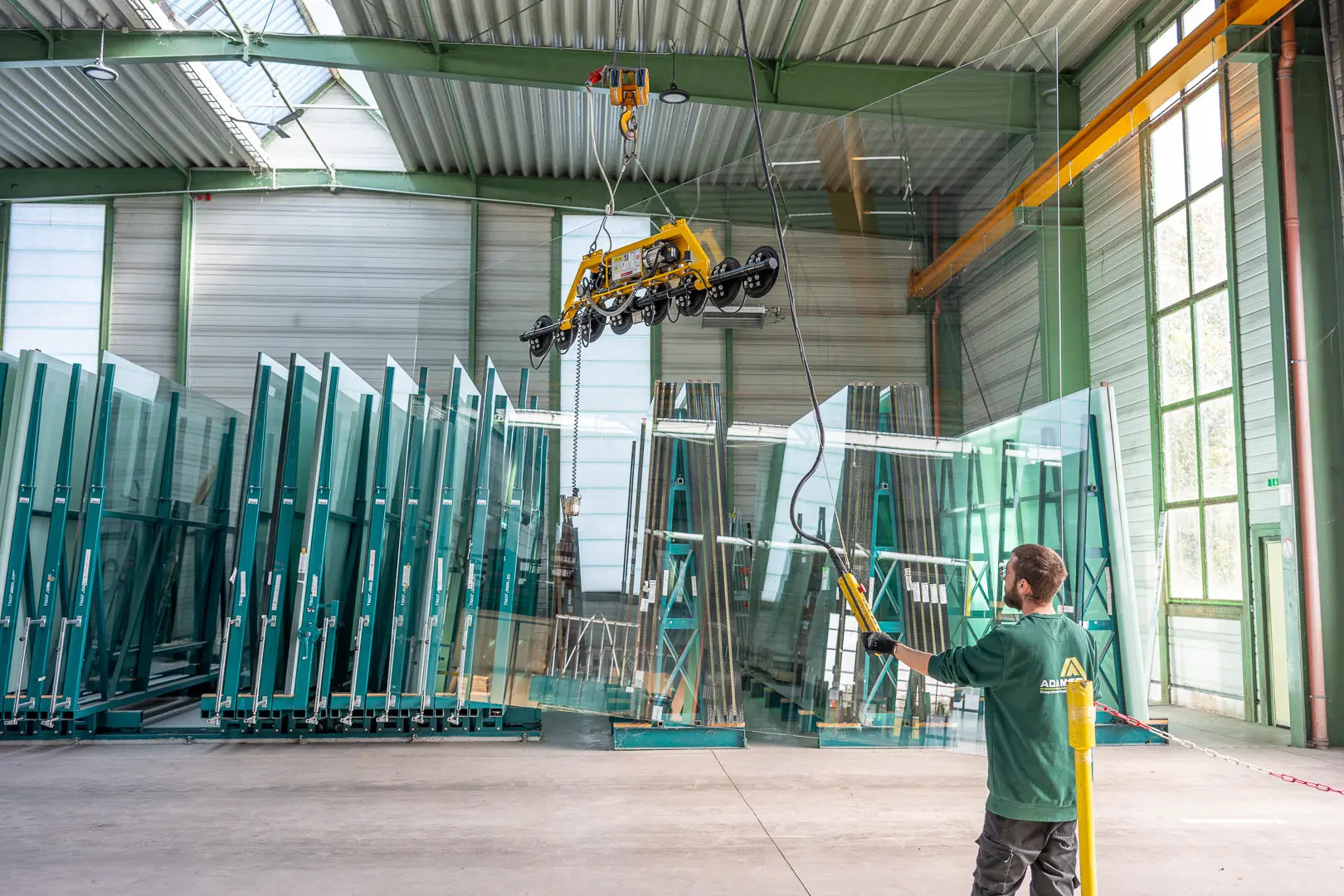
You need custom safety glass, but which type? Toughened safety glass (ESG) or laminated safety glass (VSG)? Making the wrong choice costs time, money, and in the worst case, your safety. This guide clearly explains the difference, lists specific areas of application, and shows you how to make the right decision before you order.
At Adamer, a family-run glass specialist with roots dating back to 1857, we advise private individuals, architects, and business professionals on this very question every day. Since 2011, we have been producing ESG and VSG ourselves at our subsidiary, Adamer Sicherheitsglas GmbH in Kösching, which means we know both types of glass not just from trade, but directly from the manufacturing process.
What is safety glass?
Standard float glass breaks into long, sharp shards, posing a serious risk of injury. Safety glass is manufactured or assembled in such a way that, in the event of breakage, it either disintegrates into harmless pieces or holds together as a whole. Our article on modern flat glass manufacturing explains how glass becomes a homogeneous, flat product in the first place—a good starting point if you want to understand what goes into the raw material.
There are two fundamentally different types: single-pane toughened safety glass (ESG) and laminated safety glass (VSG). Both are safety glasses, but they have very different properties and areas of application. Which type is right for you depends on where and how the glass is being used.
ESG: Toughened safety glass explained
ESG is created through thermal toughening: a standard glass pane is heated to over 600 °C and then rapidly cooled. This process creates internal compressive stress, which makes the glass significantly more resistant than conventional float glass.
Breakage behavior: If ESG breaks, it disintegrates into many small, blunt crumbs without sharp edges, which is significantly less dangerous than normal glass.
According to the Federal Association of Flat Glass (Bundesverband Flachglas), ESG is up to five times more break-resistant than conventional float glass of the same thickness, tested in accordance with DIN EN 12150. Breakage patterns, dimensional tolerances, and labeling requirements for ESG are mandatory under this standard.
Typical areas of application for ESG
- Shower enclosures (6–8 mm)
- Kitchen backsplashes (6 mm)
- Glass table tops (12 mm)
- Interior doors and partition walls (8–12 mm)
VSG: Laminated safety glass explained
VSG consists of at least two panes of glass that are permanently bonded together by a tear-resistant PVB or EVA film. If the glass breaks, the film holds all the shards together, similar to a car windshield.
Breakage behavior: The pane retains its shape even after breakage. No shards fall out. This is crucial for overhead glazing or anywhere where falling shards could endanger people.
Typical areas of application for VSG
- Patio roofs and canopies
- Glass railings and balustrades
- Burglary-resistant glazing
- Bullet-resistant glazing
- Walkable glass surfaces
- Roof glazing
According to the Federal Criminal Police Office (BKA), approximately 47% of all attempted burglaries in Germany failed in 2022. Modern safety glass is considered one of the most effective forms of passive protection, and VSG plays a central role in this. Those looking to secure their home can also find a good overview of sensible overall burglary protection measures at the Verbraucherzentrale (Consumer Advice Center).
ESG vs. VSG: A direct comparison
|
Feature |
ESG |
VSG |
|
Production |
Thermal toughening (>600 °C) |
Laminating with PVB/EVA film |
|
Breakage behavior |
Disintegrates into blunt crumbs |
Shards held by film |
|
Splinter protection |
Good (blunt pieces) |
Very high (no falling shards) |
|
Typical applications |
Shower, kitchen, table, interior door |
Patio roof, railing, burglary/bullet protection |
|
Standard approval |
DIN EN 12150 |
DIN EN 14449 |
|
Price trend |
More affordable |
Higher |
ESG or VSG? How to make the right choice
The right answer depends entirely on where and how the glass is used. Understanding this ensures you won't make the wrong decision.
For interior areas: When ESG is sufficient
In interior areas where there is no risk of falling and no overhead glazing is planned, ESG is in most cases the right and more cost-effective choice. In our overview of the areas of application for flat glass, you can see how versatilely glass is used both indoors and outdoors; ESG accounts for a large portion of interior applications.
Recommended areas of application for ESG with glass thickness:
- Shower enclosure: 6–8 mm
- Kitchen backsplash: 6 mm
- Glass table top: 12 mm
- Interior door: 8–10 mm
- Shelf board: 6–8 mm
- Partition wall (no fall protection required): 8–12 mm
Important note: ESG is not suitable for overhead glazing or fall-protection applications. VSG is mandatory in those cases.
For outdoor areas and safety applications: When VSG is mandatory
In outdoor areas and wherever people could be endangered by falling shards, German building standards dictate the use of VSG. The DGUV (German Social Accident Insurance) clearly states that VSG is fundamentally required for overhead areas and that ESG is only permitted for installation heights of 4 m or more above the floor as ESG-H (which has passed the Heat Soak Test).
Applications where VSG is mandatory:
- Patio roofs and canopies (overhead glazing)
- Glass railings and balustrades (fall protection)
- Walkable glass surfaces
- Burglary-resistant glazing
- Bullet-resistant glazing
- Structural glass facades
Using ESG for overhead and fall-protection applications does not comply with German building standards and poses a serious safety risk.
Special case: VSG made from ESG
VSG can also be manufactured using two toughened ESG panes, known as "VSG made from ESG." This combination merges the increased break resistance of ESG with the splinter protection of VSG.
Typical areas of application include heavily loaded glass railings, structural glass walls, and sophisticated overhead glazing. Whether VSG made from ESG makes sense for your application is best clarified in a personal consultation; check out our frequently asked questions or contact us directly.
Determining dimensions correctly: How to avoid expensive mistakes
The most common and expensive mistake when buying custom safety glass is incorrect measurements. This is especially critical for ESG: once the toughening process is complete, the glass can no longer be cut, drilled, or modified. A pane ordered with the wrong dimensions is waste.
Step-by-step: How to measure correctly
- Unit of measurement: Always measure and state in millimeters (mm), never centimeters
- Format: Width × height in mm, for example, 800 × 1200 mm
- Measure the clear width: Measure the open space, not the frame
- Account for tolerances: Plan for 2–3 mm of clearance per side for frame inserts
- Double-check: Measure twice, order once
- When in doubt, get advice: Especially with irregular shapes or tight space conditions
Adamer's experts will check your measurements before production, free of charge and with no obligation.
Custom safety glass from Adamer: What our experience means
What should you look for in a provider when ordering custom safety glass?
In-house production since 2011: Not every online provider manufactures their own glass. Since taking over ESG production in 2011 and founding Adamer Sicherheitsglas GmbH in Kösching, we have been manufacturing ESG and VSG ourselves—Made in Germany, controlled quality, and short delivery routes. As a company, we look back on a corporate history that dates back to 1857 as a glazing shop in Regensburg.
Direct consultation: No call center, no ticket system. At Adamer, you speak directly to the expert who also produces your pane. This makes a difference—especially with special dimensions or unclear requirements.
Tiered pricing: Those who order multiple panes pay less per piece. This is particularly relevant for craftsmen, architects, and small businesses.
Standard compliance: All products comply with applicable German and European standards. DIN, the German Institute for Standardization, provides the binding framework for quality and safety, which Adamer follows in its production.
The German flat glass market had a production value of around 2.3 billion euros in 2022, with safety glass accounting for a growing share. You can read more about the company and its history on the About Us page.
5 common mistakes when buying custom safety glass
These five mistakes are the most common when buying custom safety glass—and they are all easy to avoid.
1. Using ESG for overhead or fall-protection applications
Using ESG for overhead glazing or fall-protection applications does not comply with German building standards and poses a serious safety risk. In the event of breakage, glass pieces can fall and injure people. The correct alternatives for these areas are VSG or VSG made from ESG. Our article "When is safety glass necessary?" explains in detail which situations require safety glass.
2. Choosing the wrong glass thickness for the span
A pane that is too thin will deflect under load or break; the glass thickness must match the span and the expected load.
Reference values for orientation:
- Shower enclosure: 6–8 mm
- Kitchen backsplash: 6 mm
- Glass table top: 12 mm
- Glass railing: from 10 mm VSG
- Overhead glazing: Expert advice required
If you are unsure, we always recommend professional advice, which is free at Adamer.
3. Stating measurements in centimeters instead of millimeters
Glass manufacturers work exclusively in millimeters. A deviation of just 1 mm can result in the pane not fitting, especially with tight frame constructions. Double-check all measurements and always provide them in the format width × height in mm.
4. Forgetting edge processing
Unprocessed cut edges are sharp and unsuitable for visible or hand-touched areas. Edge processing must be determined before ordering; subsequent changes are not possible.
Common options:
- Seamed edge: For panes that will be hidden inside a frame
- Ground edge: Standard for visible but not exposed areas
- Polished edge: For high-quality visible areas, e.g., glass tables
5. Skipping the Heat Soak Test for large ESG panes
ESG can contain nickel sulfide inclusions, which in the worst case can lead to spontaneous breakage. The Heat Soak Test reveals these inclusions before the pane is installed. The Wikipedia page on toughened safety glass also explains this phenomenon clearly and makes it obvious why the test should not be skipped for safety-relevant applications.
Recommendation: The Heat Soak Test should not be missed for large ESG panes (from approx. 1 m²) and for safety-relevant applications. Adamer offers this service; just ask us about it.
Configure your custom safety glass now
The decision between ESG and VSG is easier than you think if you know the three decisive questions:
- Interior area with no fall risk? → ESG is usually sufficient
- Outdoor area, overhead, or fall protection? → VSG is mandatory
- Highest requirements for break resistance and splinter protection? → VSG made from ESG
If you are unsure which glass type, thickness, or edge finish is right for your project, the experts at Adamer are here to help.
Configure custom safety glass now →
Frequently asked questions about custom safety glass
What is the difference between ESG and VSG?
ESG is a single, thermally toughened pane that disintegrates into blunt crumbs upon breakage. VSG consists of two or more panes connected by a tear-resistant film; when broken, the film holds all the shards together. ESG is more affordable; VSG offers more safety for fall-protection and overhead applications, as well as for burglary and bullet protection.
Can I cut custom safety glass myself?
No. ESG cannot be cut or modified after the toughening process. While VSG can be cut, it requires special tools. All dimensions must be finalized before production.
What glass thickness do I need?
That depends on the application and the span. As a rough guide: showers 6–8 mm, table tops 12 mm, railings from 10 mm VSG. If you are unsure, we recommend a free consultation with Adamer.
How long does delivery take?
Delivery time depends on size, glass type, and current production capacity. It is usually 3–7 business days. For precise information, contact Adamer directly.
How much does custom safety glass cost?
The price depends on the glass type, thickness, dimensions, and edge processing. ESG is generally cheaper than VSG. Adamer offers tiered pricing for larger quantities. Configure your glass directly in the online shop.
Is safety glass suitable for outdoor areas?
Yes, but only VSG is approved for outdoor areas, overhead glazing, and fall-protection applications. According to German building standards, ESG must not be used there.


