

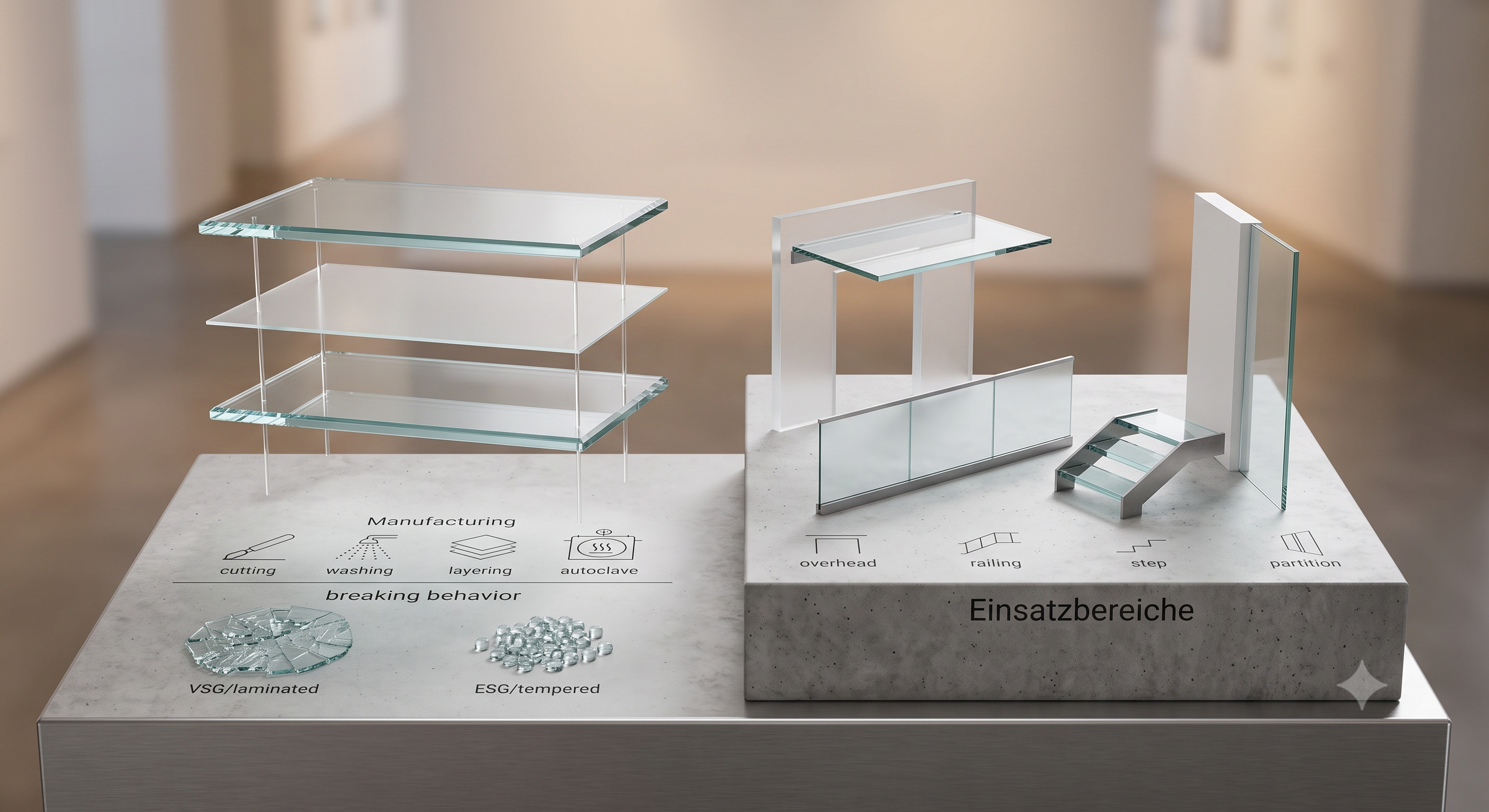
What is VSG glass? VSG glass, short for laminated safety glass (VSG), consists of at least two panes of flat glass that are permanently bonded together by a tear-resistant, tough-elastic PVB film. If the pane breaks, the shards remain stuck to the film instead of falling down or causing injury through sharp-edged fragments.
The name itself reveals the principle: "Laminated" (Verbund) stands for the multi-layered structure of glass and film, while "safety" (Sicherheit) refers to the controlled breakage behavior. This distinguishes VSG fundamentally from tempered safety glass (ESG), which consists of only a single thermally toughened pane. We explain in detail how both types of glass differ in practice in our guide Custom Safety Glass – ESG or VSG.
How is laminated safety glass constructed?
Laminated safety glass consists of two or more panes of base glass, usually float glass, ESG, or heat-strengthened glass (TVG), with one or more PVB intermediate films in standard thicknesses of 0.38 mm or 0.76 mm.
The base glass can be standard float glass, but also pre-hardened ESG or TVG, depending on the combination of impact resistance, residual load-bearing capacity, and thermal shock resistance required for a project. Between the panes lies the PVB film (polyvinyl butyral), which ensures splinter binding and can be supplemented with sound insulation or sun protection functions depending on the application. According to the Federal Association of Flat Glass (Bundesverband Flachglas), this film is precisely what prevents burglars from entering unimpeded after shattering a pane—a reason why VSG is so frequently used for burglary protection.
Production: From cutting to the autoclave
Production begins with precision cutting of the glass panes and, if necessary, tempering to produce ESG. Subsequently, the glass and film are laid together like a sandwich, pre-pressed under heat, and finally bonded under high pressure in an autoclave.
This production step determines the quality and longevity of the VSG, and this is exactly where the difference between a pure cut-to-size shop and a specialist company with its own production becomes apparent. Adamer Sicherheitsglas has been producing ESG and VSG in its own manufacturing facility in Kösching since 2011; prior to that, Adamer had been operating as a traditional glazier's workshop since 1857.
VSG glass vs. ESG glass: The difference at a glance
ESG is a single, thermally hardened pane that shatters into small, harmless granules when broken. VSG consists of several bonded panes and retains a certain residual load-bearing capacity after breaking, which is important for overhead glazing and fall protection.
|
Feature |
ESG (Tempered Safety Glass) |
VSG (Laminated Safety Glass) |
|
Structure |
A single thermally toughened pane |
At least two panes with PVB film |
|
Breakage behavior |
Shards into small, blunt granules |
Fragments remain stuck to the film |
|
Residual load-bearing capacity |
None |
Present, depending on construction |
|
Post-processing |
Not possible after hardening |
Limited possibility, only with VSG from float glass |
|
Typical use |
Shower screens, glass doors, large window areas |
Overhead glazing, balustrades, burglary protection |
A more in-depth comparison, including standards and use cases, can be found in our article Custom Safety Glass – ESG or VSG.
A practical example makes the construction tangible: A VSG shower screen often consists of two 4 mm thick ESG panes and one 0.76 mm thick film, making for an 8.76 mm thick laminated safety glass that withstands even greater loads (construction according to our guide What is Satinized Glass). You can find the right base glass for such a setup in our ESG collection, for instance as Clear Tempered Safety Glass or Satinized Tempered Safety Glass.
When do I need VSG glass? The most important areas of application
VSG is mandatory or strongly recommended for overhead glazing, fall protection, patio roofs, walk-on glass surfaces, and anywhere where a pane must not fall down after breakage.
Typical areas of application for VSG glazing are:
- Overhead glazing such as glass canopies, conservatories, and patio roofs
- Fall-protection glazing on balconies, galleries, and stairs, regulated according to DIN 18008-4
- Walk-on glazing such as glass steps and glass bridges, where residual load-bearing capacity is crucial
- Burglary-resistant glazing on floor-to-ceiling windows and patio doors
- Shop windows and shop fitting, where insulating glass or VSG is often used
- Bullet-resistant glazing, where several VSG layers are combined into so-called bulletproof glass
VSG also makes a difference acoustically: depending on the glass thickness and film structure, VSG glazing achieves sound insulation values of 35 to 52 decibels according to Glas Trösch—a side effect that often tips the scales in favor of VSG over ESG in busy locations or near railway tracks.
VSG glass weight: What you should know before ordering
Glass weighs a flat 2.5 kg per millimeter of thickness and square meter. For VSG, the film thickness—usually 0.38 mm or 0.76 mm—must also be included in the calculation, as it measurably influences the total weight.
Anyone planning a 10 mm VSG pane (2 x 5 mm glass plus 0.76 mm film) should not just estimate the weight but calculate it exactly, especially for large-format panes that are carried by hand or mounted with U-profiles. We explain the complete formula, a weight table by glass thickness, and the point at which a pane should no longer be carried alone in our guide Calculating Glass Weight.
Can VSG glass be cut?
VSG made from float glass can generally be cut afterward; VSG made from already hardened ESG, however, cannot. In both cases, special tools are required for the intermediate film, which is why cutting by a specialist company is recommended.
Those who want to use an angle grinder or glass cutter themselves can find background information on tools, technique, and the limits of DIY in our article Cutting Glass – What works and what doesn't.
Ordering custom VSG glass: What matters
Anyone wanting to order VSG glass to size should primarily pay attention to the supplier's depth of manufacturing. Adamer has been producing ESG and VSG fully automatically at its own site in Kösching since 2011, including individual refinements such as printing, surface treatment, and colored films. Standardized glass types such as Tempered Safety Glass, Clear Glass, or Satinized Glass can be configured to size directly in the shop; since VSG configurations are highly project-specific depending on film thickness, pane combination, and refinement, it is best to clarify dimensions and construction through personal contact, rather than through a middleman who does not produce it themselves.
Caution is also advised with structured surfaces: Not every glass can be bonded into VSG. With embossed ornamental glass, for example, the structured surface prevents reliable bonding with the PVB film; more on this in the guide Ornamental Glass: Types, Patterns, and Areas of Application.
How sustainable is VSG glass?
A point that most VSG guides have ignored until now: recyclability. To date, the majority of retired VSG panes end up crushed in glass wool or container glass production because separating glass and PVB film by type is difficult. However, according to gff-Magazin, researchers at the TU Darmstadt developed a four-stage separation process in 2025 that, for the first time, breaks down VSG into pure glass and PVB without breaking the glass—a step forward that brings closed-loop recycling in construction practice closer.
Economically, VSG remains unaffected by this: While the entire flat glass market in Germany was in decline in 2024, laminated safety glass recorded a much more moderate decrease of -6.5% compared to, for example, insulating glass (-7.5%) according to Glaswelt—a slight increase is even expected for 2025. The crime statistics also show that safety glass generally has its place: According to the Federal Association of Flat Glass, around 46% of all attempted burglaries fail, partly due to resistant glazing. In total, approximately 1.8 million tons of flat glass were produced in Germany annually recently, the basis from which VSG is also created (Source: Statista/Federal Association of the Glass Industry).
What is VSG glass and when is it the right choice?
The answer to the question "What is VSG glass" can be summarized as follows: a safety glass made of at least two bonded panes that is the right choice wherever a pane must not simply fall down after breaking, from overhead glazing to burglary-resistant patio doors. Anyone wanting to order custom VSG glass should pay attention to tested production quality, the appropriate film structure, and the often underestimated film thickness when calculating weight. With its own production since 2011 and over 165 years of experience in the glass craft, Adamer supports projects from consultation to the custom-made VSG pane.
Frequently asked questions about What is VSG glass
Which glass is better, ESG or VSG?
As a rule, neither is "better"; it depends on the intended use. ESG is more economical and sufficiently impact-resistant for shower screens or glass doors. VSG is the right choice when residual load-bearing capacity is required, such as for overhead glazing or fall protection.
What are the disadvantages of laminated safety glass?
VSG is heavier and more expensive than ESG, production in an autoclave is more complex, and post-processing is only possible with VSG made from float glass. Furthermore, the PVB film is currently difficult to separate from the glass, which complicates recycling.
What are the three types of safety glass?
The three most common types are ESG (tempered safety glass), VSG (laminated safety glass), and TVG (heat-strengthened glass); the latter is often used as base glass for VSG.
What are the alternatives to VSG glass?
Depending on the requirement: ESG if no residual load-bearing capacity is needed, or wired glass, a classic safety glass with embedded wire mesh. From a normative perspective, however, there is hardly a full-fledged substitute for VSG for fall protection or overhead glazing.
Is VSG glass expensive?
As a rule, yes; VSG is more expensive than ESG due to the amount of material, film, and the autoclave process. The exact costs depend on glass thickness, film thickness, and dimensions.


