

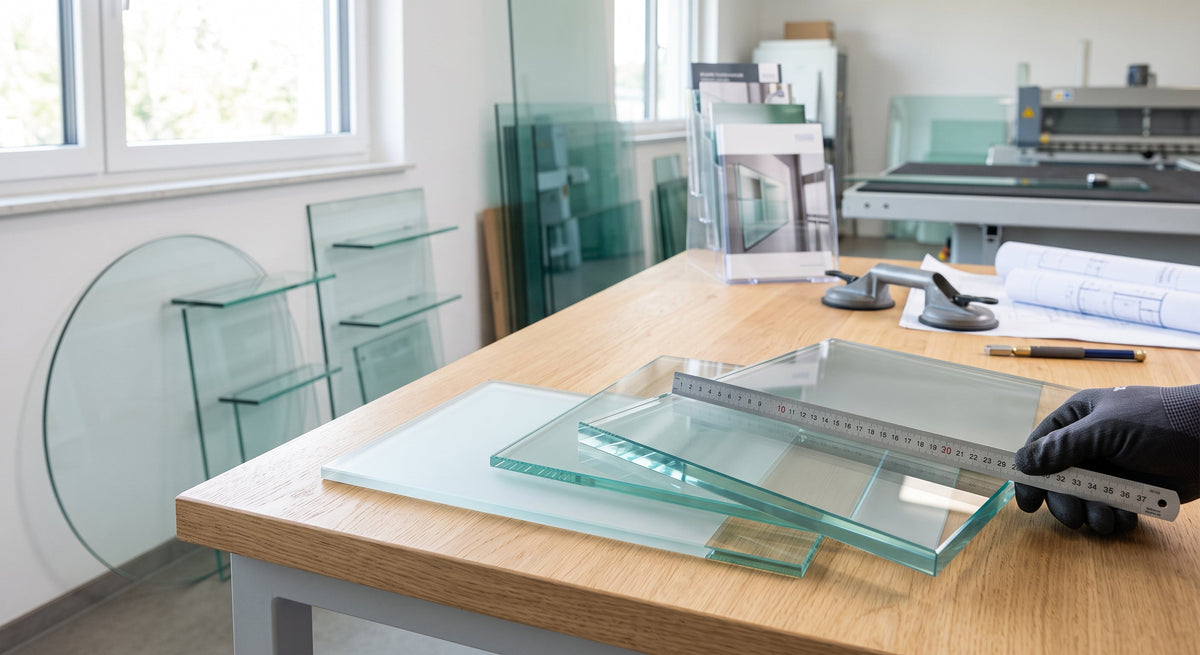
A shelf that doesn't break, but merely splinters. A tabletop that clouds over after two years. A display case that reflects instead of showcasing. Almost every annoyance concerning custom-made glass plates has the same cause: the wrong type of glass for the specific purpose. This guide shows which glass plate fits which project, what thickness is truly necessary, and what you should look out for regarding cutting and shape.
Flat glass, the material group behind every glass plate, accounts for around 27 percent of total German glass production according to the Federal Environment Agency, the second-largest share after container glass (Umweltbundesamt). The market for glassware in Germany is estimated at a production value of around 54.7 billion euros in 2025 (Statista Market Insights), proof of how firmly anchored glass is in furniture construction, interior design, and craftsmanship.
What are custom-made glass plates?
Custom-made glass plates are individually cut flat glass elements whose length, width, thickness, and edge shape you determine yourself. They are used as shelves, tabletops, furniture fronts, or display case panes and are manufactured from various types of glass.
Typical areas of application for custom-made glass plates are:
- Shelves in open or closed shelving systems
- Tabletops for dining tables, coffee tables, or desks
- Furniture fronts and shelves in cabinets and display cases
- Kitchen backsplashes and splash guards behind stoves or sinks
- Picture frame and display case glazing for exhibits
In everyday language, the term "glass plate" is often equated with "glass pane," but technically they differ slightly. And exactly this distinction determines later on which glass you should order in the first place.
Glass plate or glass pane: What is the difference?
A glass pane usually refers to a thin, transparent flat glass element, such as for windows or picture frames. A glass plate tends to be thicker and more stable because it assumes a load-bearing or free-standing function, for example as a tabletop or shelf.
In practice, both terms blur. Anyone searching online for "custom glass pane" often means the same product as someone asking for "custom glass plate." More important than the designation is the question of load: Is the surface touched, loaded, or even walked upon? The appropriate glass type and thickness depend on this, not on the chosen search term.
Which glass type is suitable for your custom-made glass plate?
Not every type of glass is suitable for every purpose. The following overview shows four common options at Christian Adamer GmbH and what they are actually suitable for.
Float glass: the standard solution for clear glass plates
Float glass is the basis for almost all custom-made glass plates. It is created by floating liquid glass on a tin bath, forming a uniformly flat surface. The result: absolute clear visibility, available from as little as 0.5 mm thick.
When looking through the surface, float glass remains colorless. At the edge, however, it shows a slight greenish shimmer, a typical feature caused by the natural iron content in the raw material. For display cases, picture frames, or shelves without special safety requirements, float glass is therefore usually the right and most economical choice. German flat glass manufacturers exported around 62.6 percent of their production in 2024, an indication of the internationally sought-after "Made in Germany" quality (Federal Glass Industry Association). Details on formats, edges, and typical pitfalls during cutting are provided in our practical guide to custom float glass. You can find the right product directly in the float glass range.
ESG glass plates: more safety for shelves and tabletops
In brief: Tempered safety glass (ESG) is thermally hardened float glass. In an emergency, it breaks into small, blunt crumbs instead of sharp-edged splinters and is therefore particularly suitable for heavily used or free-standing glass plates.
The difference is measurable: According to DIN EN 12150-1, ESG must reach a bending strength of at least 120 N/mm², compared to around 45 N/mm² for simple float glass (BauNetz Wissen). For custom-made glass plates, this means: shelves with heavy loads, tabletops in households with children, or furniture fronts in high-traffic rooms are noticeably more robust with ESG. Certification bodies such as ift Rosenheim regularly test exactly such safety glasses for their breakage behavior (ift Rosenheim).
One point is decisive for ESG, however: Hardening only takes place after cutting. Changes to dimensions, shape, or drill holes are not possible afterward, because the pane would shatter immediately. Therefore, plan the final dimensions carefully before ordering an ESG glass plate. The entire ESG range with clear, satin, and colored variants can be found in the ESG collection; our article What is ESG glass? explains the manufacturing and standards.
Satin glass and frosted glass: opaque custom-made glass plates
When light should pass through but not the view, the path usually leads to satin glass. The surface is matted by acid etching or sandblasting, usually on one side, so that one side remains smooth and the other opaque. For kitchen fronts, bathroom glass elements, or display cases with privacy screens, the satin float glass from Adamer is the obvious choice. Scratch resistance is not a standard feature here, but a separate additional treatment—a topic researched by institutes like the Fraunhofer ISC with special surface coatings (Fraunhofer ISC). You can find all properties and care instructions in our guide to satin glass.
Genuine frosted glass is created differently, namely either by opacifiers directly in the glass melt or by a fused-on white flashed layer. Adamer carries this variant as a special product that is particularly suitable for design accents and light-diffusing effects, for example with backlit elements. For classic privacy on furniture and doors, however, satin glass remains the more practical and versatile solution.
Anti-reflective glass for display cases and picture frames
Anyone who has tried to photograph a picture behind glass knows the problem: reflections swallow every detail. For picture frames and display cases, anti-reflective glass is therefore the better custom-made glass plate than float glass. It significantly reduces light reflections and shows content almost as if there were no pane at all. Special glass manufacturers like SCHOTT have been driving the development of such low-reflection coatings for years (SCHOTT AG). The corresponding product is available in the anti-reflective glass range.
Why the origin of the glass plate matters
Not every provider that sells custom-made glass plates manufactures them themselves. Many online shops buy raw glass and pass the cutting on to subcontractors, which increases delivery times and makes quality control more difficult. Adamer has been operating as a specialist glass company in Bavaria since 1857, back then still as a traditional glazier without its own safety glass production. Since 2011, Adamer has been producing ESG and VSG safety glass in its own fully automated production facility in Kösching. For custom-made glass plates, this means short distances between cutting, hardening, and quality inspection, instead of several intermediate stations.
Glass type comparison: Which glass plate fits which project?
|
Glass Type |
Transparency |
Breakage Behavior |
Typical use as glass plate |
Common Thicknesses |
|
Float glass |
Clear, slightly greenish edge |
Sharp-edged fragments |
Shelf, display case, decor |
from 0.5 mm |
|
ESG |
Clear or satin |
Small, blunt crumbs |
Tabletop, heavily used shelf |
4 – 12 mm |
|
Satin glass |
Opaque, translucent |
Like base glass (Float or ESG) |
Furniture front, partition, bathroom |
4 – 8 mm |
|
Anti-reflective glass |
Clear, low-reflection |
Like float glass |
Picture frame, display case |
from 2 mm |
Custom-made glass tabletops: thickness, edges, and safety
For glass tabletops, the support surface is the main factor in determining the correct thickness. As a practical benchmark, 12 mm has established itself for classic dining and living room tables; smaller side tables often manage with less, while large or self-supporting plates require more. The calculation itself is quite simple: per millimeter of thickness, a square meter of glass weighs 2.5 kilograms; with laminated safety glass, the foil thickness is also counted. An extensive table with practical examples is provided by our guide to weight calculation of glass.
For tabletops, a broken or polished edge is also recommended, as sharp glass edges are an underestimated source of injury in everyday life. Those who want to be on the safe side also combine float glass with ESG hardening so that the plate does not shatter into large, sharp pieces in the event of an accidental impact. Construction associations like the "Verband Fenster + Fassade" regularly publish updated application recommendations for safety glass.
Ordering custom-made glass shelves
Glass shelves look light and let light flow through closed shelving systems, an effect that wood or metal do not offer. The load is also crucial here: a narrow shelf for decorative objects can manage with thinner float glass, whereas a shelf for books or dishes should be made of ESG. Since the contact points on dowels or supports create point loads, the higher bending strength of ESG pays off here directly. For self-supporting or point-fixed constructions beyond simple furniture applications, the DIN 18008 standard series provides the technical design rules (DIN Media).
A practical tip: Measure the shelf depth on both sides of the shelf separately; walls and cabinets are rarely exactly at right angles. A tolerance of a few millimeters prevents the finished glass plate from not fitting in the end.
Assembly: How to securely attach custom-made glass plates?
The type of glass alone does not make a glass plate secure; the attachment is at least as decisive. For shelves, shelf supports or support dowels usually carry the load, distributed over several points instead of a single edge. For tabletops resting on an existing piece of furniture, small spacers, so-called bumpons, ensure that the glass plate does not sit directly on wood or metal and does not leave scratches when it slides.
For larger or free-standing glass plates, such as room dividers or furniture fronts, U-profiles or clamping holders are often used, which grip the plate on several sides instead of fixing it only at points. This distribution of holding forces reduces the load at every single attachment point and is often more effective for high-traffic surfaces than simply changing the glass type. Anyone planning a particularly heavily used surface, such as a partition in a commercial room, should therefore always consider the glass type and attachment system together, not in isolation.
How to order custom-made glass plates correctly?
To order a custom-made glass plate, you need the exact dimensions in millimeters, the desired glass type, the edge finish, and, if necessary, information about drill holes or cutouts. Adamer then manufactures precisely according to these specifications.
The desire for individual production is no longer a niche trend: 62 percent of German internet users expect that new manufacturing technologies will enable more customized products in the future, as a Bitkom survey shows (Bitkom). Online configurators for custom-made glass plates are therefore part of a larger shift in purchasing behavior.
This is the best way to proceed:
- Measure the area exactly. Note the length and width in millimeters, each at several points of the area.
- Determine the glass type. Choose between float glass, ESG, satin, or anti-reflective glass depending on the area of application.
- Determine the thickness. Use the weight formula or seek advice, especially for self-supporting surfaces.
- Select edges and corners. Broken, ground, or polished edges increase both safety and appearance.
- Specify drill holes and cutouts. These must be determined before hardening for ESG and cannot be changed later.
- Make an inquiry. Adamer checks the details and creates an individual offer for your custom-made glass plate.
Glass cutting: What really matters when taking measurements
A common mistake when cutting glass is confusing the desired dimension with the installation dimension. Anyone who orders a glass plate exactly to the inner dimensions of a shelf compartment risks it jamming or not fitting in at all. A small tolerance deduction, usually two to three millimeters per side, creates the necessary leeway.
Further points that influence the cutting:
- Check for squareness: Not every wall or furniture frame is built at exactly right angles.
- Determine material before hardening: For ESG, drill holes, cutouts, and final dimensions must be set before thermal treatment.
- Consider edge processing: Polished edges require slightly more space than raw edges.
Those who want to reach for an angle grinder or glass cutter themselves will find the limits of what is feasible in our guide Cutting glass: What works and what doesn't. For everything beyond a simple straight cut in float glass, cutting by a specialist company is worth it.
Square, round, or individual: What shapes are possible?
In addition to classic square glass plates, round, oval, or freely shaped variants can also be manufactured to measure. Round glass plates are particularly suitable for side tables, storage surfaces, or as a protective cover on existing furniture. Technically, a round shape places higher demands on cutting precision than a straight cut, which is why machine production is clearly superior to DIY here.
Individual shapes with cutouts, for example for cable passages or corner bevels in narrow hallways, are also possible. The more complex the shape, the more important a true-to-scale template or sketch becomes for the inquiry.
Another aspect in choosing the shape is structural mechanics. Square glass plates distribute load more evenly over the entire support surface, while round or irregularly shaped plates can create point stress peaks. For heavily used applications, such as a round tabletop for daily use, ESG is therefore more often the right choice than for a purely decorative, unloaded glass plate.
What influences the cost of a custom-made glass plate?
The price of a custom-made glass plate depends on the glass type, thickness, area, edge processing, and any special features such as drill holes. A flat price quote is therefore not very meaningful.
Instead of a table with fantasy prices, it is worth looking at the adjustment screws: ESG generally costs more than simple float glass because an additional hardening process is necessary. Larger areas, elaborate edge processing, and individual shapes also increase the price. For a reliable calculation of your specific project, a non-binding inquiry directly via the Adamer configurator is recommended.
The right custom-made glass plate for your project
The appropriate custom-made glass plate is not determined by the search term, but by the intended use. Float glass impresses for display cases and light shelves, ESG for heavily used tabletops and shelves, satin glass where light without a view is required, and anti-reflective glass wherever reflections are a nuisance. Those who consciously choose the glass type, thickness, and edge instead of leaving it to chance will receive a custom-made glass plate that lasts for years instead of months.
You now know which type of glass suits your project, but the last few centimeters make all the difference. Get non-binding advice and request your individual quote for a custom-made glass plate directly from Adamer, with personalized consultation from our own production facility in Bavaria.
Frequently asked questions about custom-made glass plates
How thick should a glass plate for a shelf be?
That depends on the span and the intended load. For light decorations, 6mm float glass is often sufficient; for books or dishes, 8 to 10 mm tempered safety glass (ESG) is recommended.
Can an ESG glass plate be cut after the fact?
No. After thermal tempering, ESG cannot be processed further; any attempt to cut it will immediately shatter the pane. Dimensions, holes, and cutouts must be determined beforehand.
Which glass plate is suitable for a tabletop in a household with children?
An ESG tabletop is the safer choice here, as it breaks into small, blunt granules rather than sharp shards in the event of breakage.
What is the difference between satin glass and frosted glass?
Satin glass is created by subsequently etching or sandblasting the surface. Frosted glass obtains its opaque appearance during the glass manufacturing process itself, either through additives in the melt or a fused overlay layer.
How thin can a custom-made glass plate be?
Float glass is available starting at 0.5 mm. However, for free-standing or load-bearing glass plates, significantly greater thicknesses are common in practice.
How do I calculate the weight of my glass plate?
Multiply the area in square meters by the thickness in millimeters and the factor of 2.5. For laminated safety glass, add the film thickness (usually 0.38 or 0.76 mm) to the total thickness.
Can I order glass plates with rounded corners instead of square edges?
Yes, rounded corners are possible with almost any type of glass and also reduce the risk of injury on furniture edges, especially in households with children.


